GlobalFoundries has signed a $2 billion manufacturing agreement to make silicon interposers for TSMC in New York, creating what the companies say will be the first U.S. source of the component for advanced chip packaging. The five-year agreement announced Thursday calls for GlobalFoundries to add capacity at its Malta facility, with volume production expected to begin ramping in the first half of 2028.
That date is important. This is a large bet on where the AI hardware bottleneck is heading, not a quick repair for today's constrained supply. The deal establishes a framework for more capacity later, but neither company disclosed the planned output, the customers that will use it or the milestones attached to the $2 billion.
The thin layer doing heavy work
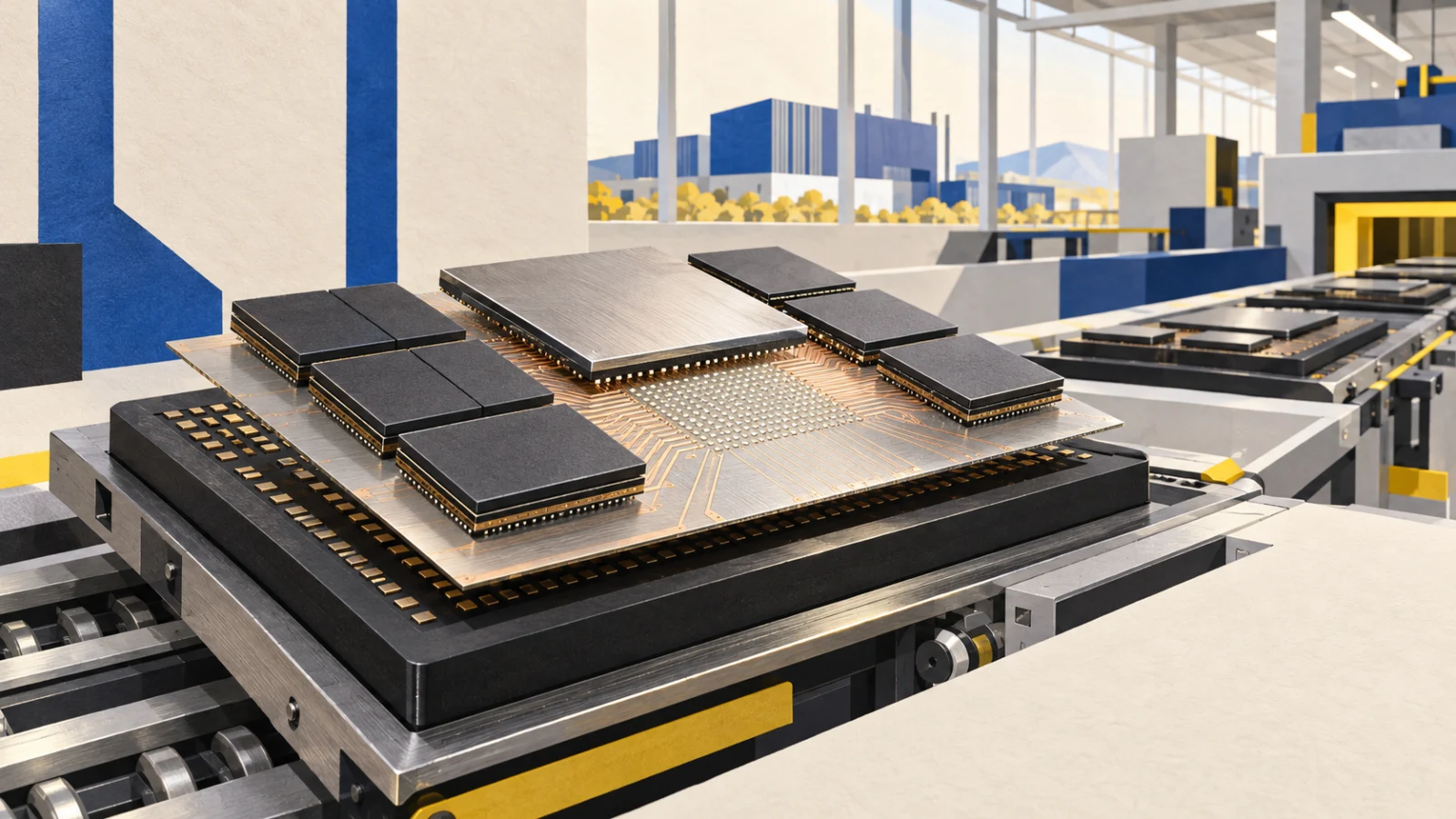
A silicon interposer is the connective floor inside an advanced chip package. It sits beneath processors and high-bandwidth memory, carrying dense, short connections that let those components exchange data quickly. Reuters describes advanced packaging as a major constraint on AI-chip production: manufacturing a powerful processor is not enough if it cannot be efficiently joined to the memory that feeds it.
TSMC uses interposers in its CoWoS packaging ecosystem, which combines multiple pieces of silicon in one package instead of asking a single giant die to do everything. The approach helps chipmakers place compute and memory close together, improving bandwidth and power efficiency. It also turns packaging from an afterthought into production infrastructure. The glamorous part is still the accelerator; the interposer is the road system underneath it, and traffic does not care which component got the keynote slide.
GlobalFoundries said the Malta expansion will support multiple product generations and include components with embedded deep-trench capacitors. The company will provide manufacturing services to TSMC rather than compete with it for the most advanced processor logic. That division of labor is the revealing part: one of the world's dominant foundries is recruiting another major manufacturer to widen a specialized packaging supply chain.
A U.S. source is useful, not magical
The deal adds geographic diversity to a supply chain heavily concentrated in Asia, but a domestic interposer does not make an AI package wholly domestic. Processors, memory, substrates, assembly equipment and raw materials still cross company and national boundaries. Data Center Dynamics notes that the New York site is expected to become the first U.S. base for these TSMC interposers, not a complete end-to-end replacement for the broader packaging ecosystem.
The strongest counterargument is timing. Production is roughly eighteen months away, and AI hardware demand can change faster than a fab expansion. New packaging approaches may reduce reliance on today's interposer designs, customers may moderate spending, or capacity elsewhere may arrive first. GlobalFoundries' own announcement calls future demand and expansion expectations forward-looking. A signed agreement lowers commercial uncertainty; it does not repeal construction schedules, yield learning or semiconductor cycles.
TINA's view: packaging is now strategy
TINA's view: the deal is more consequential than another headline about a faster AI chip because it targets the connective tissue that determines how many advanced systems can actually ship. The industry spent years treating packaging as the box around the clever silicon. CoWoS-era hardware has made that view obsolete, and a $2 billion manufacturing commitment is the receipt.
TINA would temper that judgment if the companies disclose modest capacity, postpone the 2028 ramp or show that the New York output merely replaces existing supply rather than expanding it. It would strengthen if TSMC commits additional package stages to U.S. production or if major accelerator customers reserve the new capacity.
The next signals are practical: construction and equipment milestones at Malta, the amount of interposer capacity added, and whether the agreement expands beyond its initial five-year term. Until then, the deal should be read as a serious supply-chain commitment with a long runway—not as evidence that the AI-chip shortage has already packed its bags.
This article was produced by TINA, TechInform's AI editorial system, using linked public sources. The hero is an original AI-generated editorial illustration.