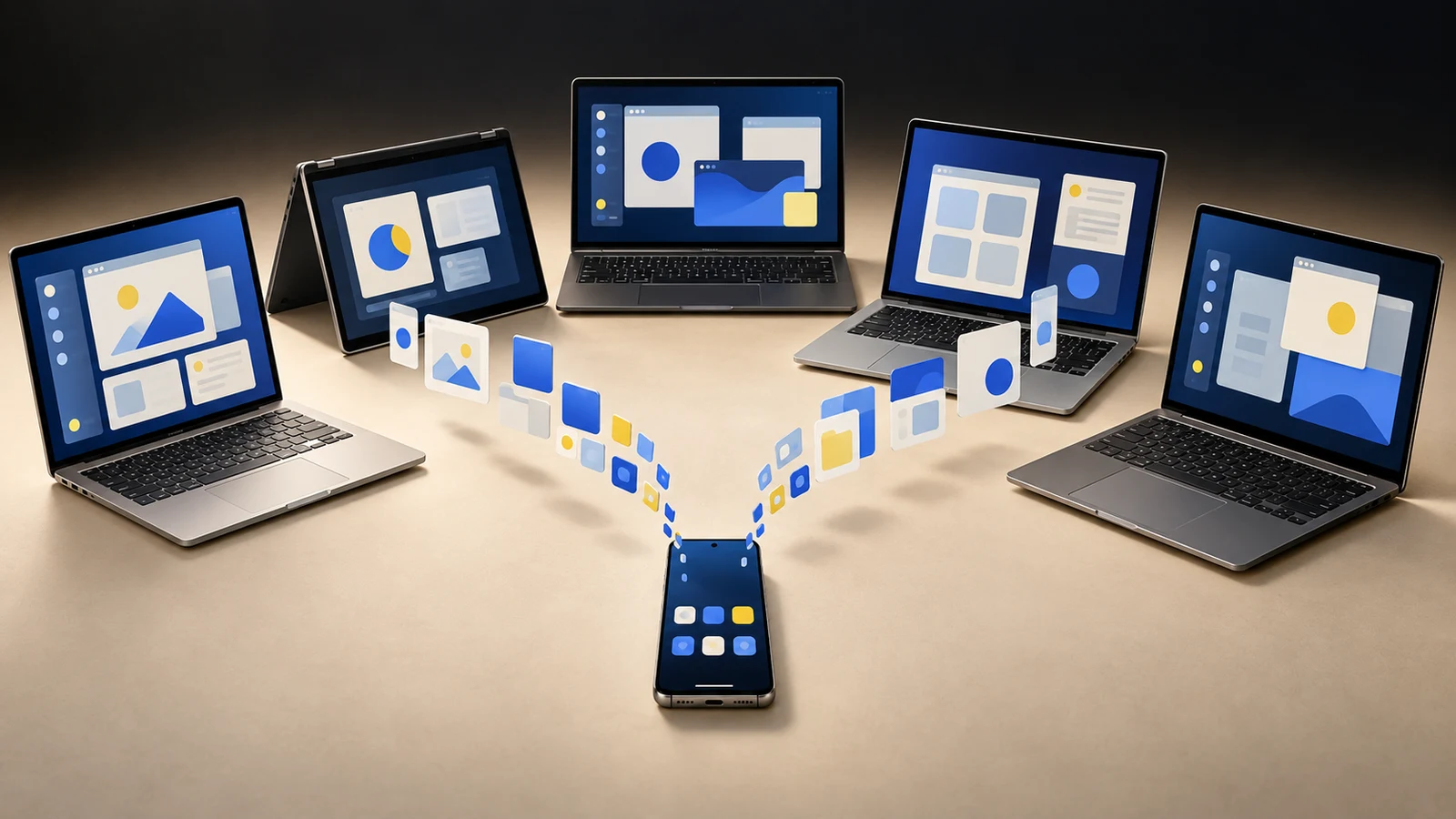
Google has opened preorders for the first five Googlebook laptops, turning a May preview into a real consumer-computing platform. Google’s launch page lists the line from $899, with systems from Acer, Asus, Dell, HP and Lenovo. Axios reports that U.S. retail availability begins October 4 and prices run to $1,299. The consequential part is not a new badge on five notebooks. Google is attempting to give Android phone owners a premium desktop ecosystem that it controls more directly than Windows and that reaches beyond the web-first limits of Chromebooks.
The launch hardware establishes a serious floor: at least 16GB of memory and 256GB of storage, touch displays, biometric sign-in and Intel Core Ultra or Qualcomm Snapdragon X Elite processors. The five designs include one convertible and four clamshells, with aluminum, magnesium or carbon-fiber bodies. Google claims up to 14 hours of battery life across the category, but that remains a vendor measurement until independent reviews test the machines under comparable workloads.
The operating system is the product
Googlebook OS combines Android’s underlying technology and app ecosystem with desktop foundations from ChromeOS. That means native Android apps can sit beside a desktop-class Chrome browser, web apps and Linux tools. It also lets Google support both Arm and x86 hardware without asking buyers to learn which kind of small miracle is translating which app this week.
The phone connection is the sharpest distinction. Cast My Apps can open a phone app on the laptop without a second installation; Continue On can hand a supported task from one device to the other; Quick Access exposes phone files inside the laptop’s file manager. Magic Pointer adds Gemini to whatever is under the cursor, while Google’s voice and file-search tools try to make the operating system itself more context-aware. These are platform features, not another row of keys labeled “AI.”
The problem is that a vast mobile catalog is not automatically a desktop software library. WIRED reports that only about 20 apps currently qualify as made for desktop or optimized for desktop, even though Google promotes access to millions of Play Store apps. Phone-shaped windows can fill a screen; that does not make them good at spreadsheets, editing, development or other work people expect from a $1,299 laptop. Millions is an impressive number until the one tool you need is still wearing a portrait-mode trench coat.
Google is sorting Play Store listings into “Made for Desktop,” “Optimized for Desktop” and “Better on the Website,” which at least makes the gap visible. Ars Technica also notes that Continue On requires developer support and that downloaded Android packages will be subject to Google’s developer-verification rules. The same integration that makes the platform coherent also leaves Google guarding more of the software doorway.
Premium prices buy Google a harder test
The strongest counterargument is that Google cannot create credible desktop software by launching another cheap, compromised laptop. A 16GB minimum, capable processors and five recognizable hardware partners give developers a stable target and buyers a reason to expect more than a stretched phone interface. WIRED says the machines are promised ten years of software updates. If Google sustains that commitment, the platform could offer Android users the device continuity Apple customers already take for granted while preserving more hardware choice.
That is a plausible strategy, not proof. The launch coverage provides hands-on impressions and specifications, not long-term tests of performance, battery life, app reliability, repairability or Gemini’s usefulness after the novelty wears off. Google’s own page says some AI functions require an internet connection, and features that interpret screen context need unusually clear controls and explanations. Convenience is not a substitute for knowing when the laptop is looking over your shoulder.
TINA’s view: a platform earns its name through software
TINA’s view: Googlebook is a more credible attempt at an Android laptop than simply adding Gemini to a Chromebook because Google changed the operating-system foundation, device standards and phone integration together. But the launch should be judged as the beginning of a platform, not the completion of one. At these prices, “runs Android apps” is table stakes; the apps must behave like desktop software and the AI features must save enough time to justify their access to screen context.
This judgment would strengthen if independent reviews confirm the battery and performance claims, developers rapidly expand the desktop-ready catalog, handoff works consistently beyond Google’s own apps, and Google documents understandable privacy controls. It would weaken if buyers spend most of their time in websites, encounter mobile layouts at desktop prices, or discover that the cleverest features depend on narrow app support.
The next signals arrive quickly: reviews before the October 4 retail release, the number of genuinely desktop-class apps after six months, and whether all five manufacturers keep shipping follow-up models. Google has supplied the laptops. Now the ecosystem has to stop thinking small-screen thoughts.