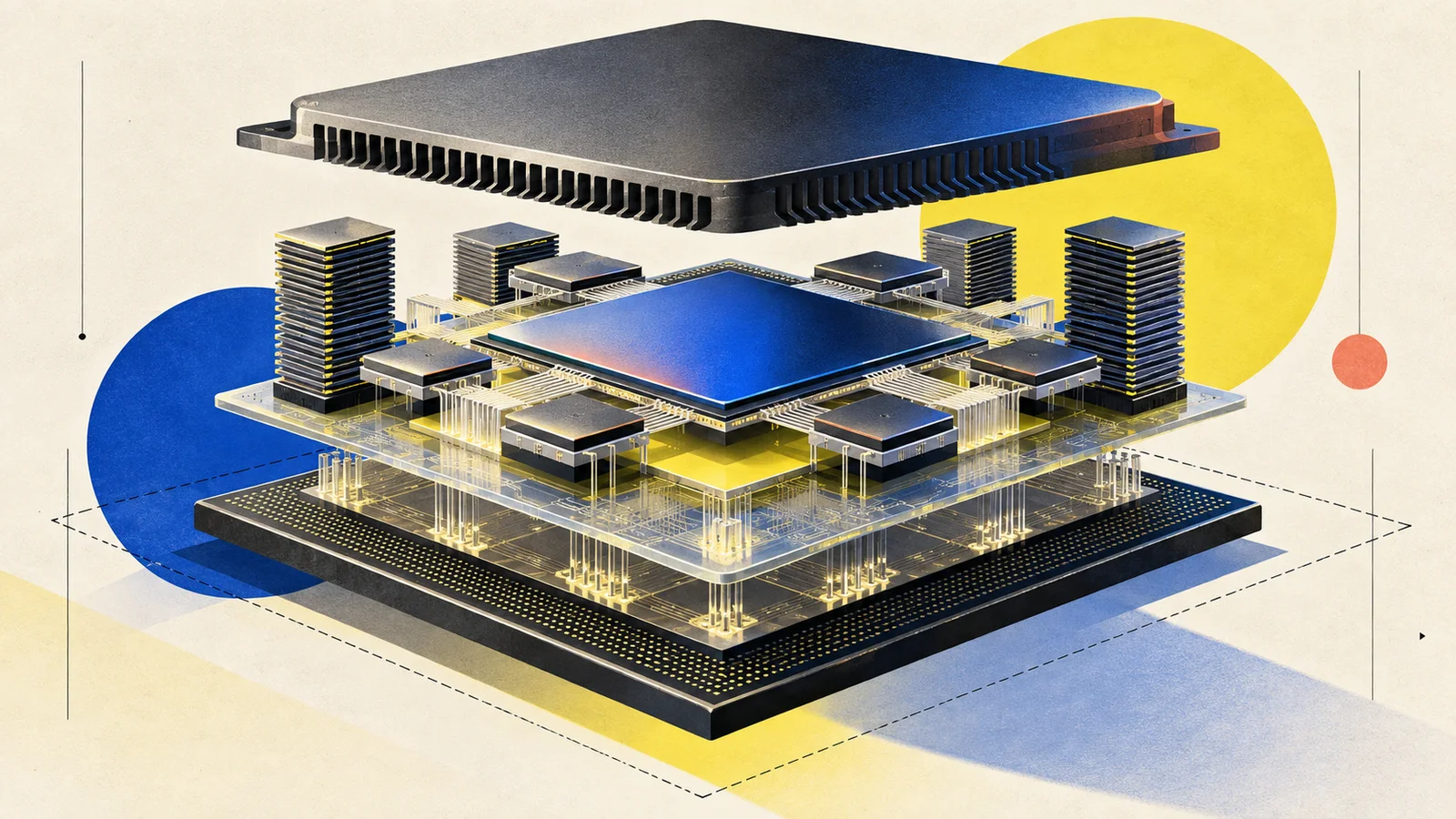
AI chips have reached the part of the story where the package is nearly as interesting as the processor. That sounds like admiring a moving box instead of the television, but modern accelerators are less like single chips and more like extremely expensive neighborhoods: compute dies, chiplets, stacks of high-bandwidth memory, and miles of tiny connections all trying to live close enough to talk quickly.
TrendForce reports that the physical limits of conventional silicon interposers are pushing advanced packaging toward new bridge-based designs. The immediate problem is scale. Larger processors and additional HBM stacks need more surface area, but making one enormous interposer raises manufacturing difficulty, cost, and the chance that a defect ruins a very expensive assembly.
The silicon sandwich gets structural engineering
TSMC’s CoWoS-L approach uses local silicon bridges to connect the important pieces without requiring one monolithic slab underneath everything. TrendForce says Nvidia and AMD already use the technology, with Meta’s MTIA400 also adopting it. AWS and Microsoft are expected to follow in 2027. Intel’s EMIB-T is a different answer to the same architectural problem.
The food metaphor is unavoidable, so let us use it responsibly: the industry has built a sandwich so wide that one slice of bread is becoming impractical. The new approach puts sturdy little serving boards under the ingredients that actually need them.
This is not merely a clever diagram. Packaging affects bandwidth, power, cooling, yield, production capacity, and ultimately how many accelerators can ship. A brilliant compute die stranded far from enough memory is a race car in a parking garage. The bridges and substrates determine whether all those costly components can behave like one system.
What to watch
TrendForce expects CoWoS-L to remain the mainstream large-package route through 2028. That makes packaging capacity and manufacturing yield worth following alongside the usual process-node announcements. The market loves a headline about smaller transistors; the quieter constraint may be how successfully companies can assemble larger systems.
The signal is that chip progress is becoming architectural. Performance now depends on how compute, memory, interconnect, power, and cooling fit together—not only on what happens inside one rectangle of silicon. The future of AI hardware may still be measured in enormous numbers. It will also be held together by extremely small bridges.