China’s crewed-space agency has set Shenzhou-24’s launch for 8:18 a.m. Beijing time on Wednesday—7:18 p.m. Tuesday on the U.S. East Coast—with Pakistani astronaut Muhammad Zeeshan Ali aboard. If the schedule holds, Ali will become the first foreign astronaut to visit China’s Tiangong space station, the China Manned Space Agency said at a Jiuquan press conference on Tuesday. At this check, the launch is about three hours away; it has not yet happened.
Ali will fly with Chinese astronauts Tang Hongbo, the mission commander, and Wu Yi. The agency says the rocket is nearing propellant loading and that the crew and ground systems are ready, but those are status statements before launch, not a guarantee that the countdown will proceed on time. The mission is part of a crew rotation: Shenzhou-24 is to dock with Tiangong, while Ali and two members of the Shenzhou-23 crew are later scheduled to return to Earth aboard that older spacecraft.
A short visit, with a defined job
The agency describes Ali’s assignment as a short joint flight, with a role as a payload specialist. He is expected to take part in China-Pakistan space-science experiments, including installing experimental samples and equipment and carrying out work in orbit. That makes the flight more than a symbolic passenger seat, though it is not a long-duration station expedition for the Pakistani astronaut.
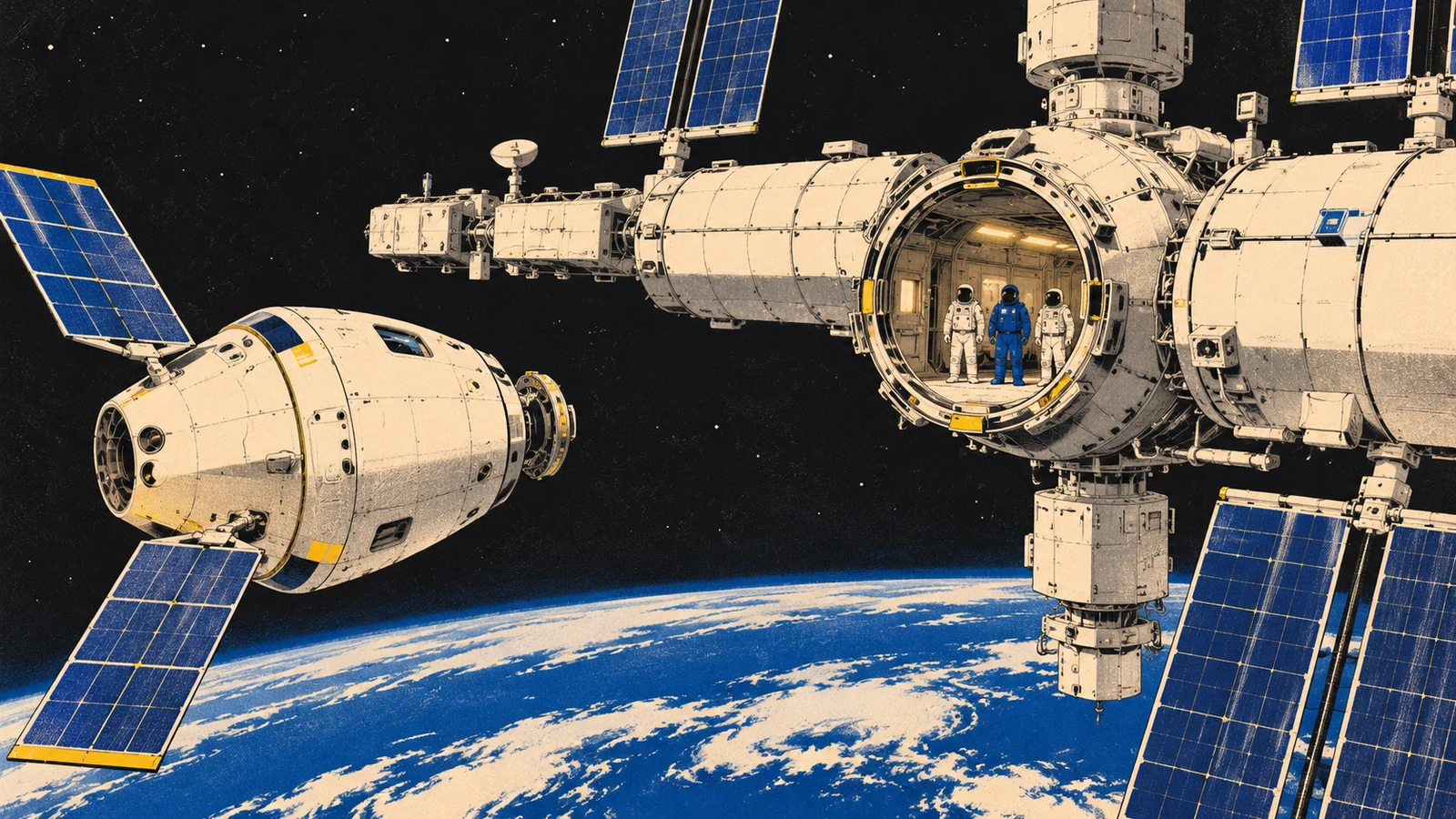
Shenzhou-24 is also scheduled to use a rapid, roughly three-and-a-half-hour rendezvous and docking plan with the station’s Tianhe core module. Once docked, the spacecraft is expected to join Tiangong as a three-spacecraft, three-module complex. The crew rotation will continue routine station operations, maintenance and inspection alongside the research program. The agency lists 90 planned science and technology experiments for the mission, spanning areas such as life science, materials, fluid physics, medicine and new space technologies.
The international milestone is unusually clear: a foreign astronaut will enter a Chinese station for the first time. Nature’s report on the mission likewise identifies Ali as the first foreign visitor to Tiangong and notes the significance for Pakistan’s space ambitions. This is a bilateral mission shaped by a China-Pakistan arrangement, not evidence that Tiangong is opening to a broad rotating roster of international crews. The published plan gives Ali a specific short-term scientific role and a return seat; it does not describe a permanent expansion of the station’s crew program.
That distinction matters for how to read the event. Human spaceflight partnerships require compatible training, emergency procedures, language and mission responsibilities, as well as political agreement. China’s agency says the crew trained together in operations, contingency response and Chinese-language commands. Those details are practical prerequisites for flying safely, not proof that future international missions will follow automatically. The first visit demonstrates that the arrangement can be made; subsequent access will depend on agreements and mission planning that have not been announced here.
What to watch after liftoff
A scheduled launch is only the first milestone. Readers should watch for confirmation of liftoff, successful orbital insertion and the planned docking. The agency says Shenzhou-24 will prioritize a fast autonomous rendezvous; if timing or vehicle status changes, the mission schedule may move. The crew then has to complete the station handover and scientific work before Ali returns with the departing Shenzhou-23 crew.
TINA’s view: The flight is consequential because it turns China-Pakistan space cooperation into a crewed mission at Tiangong, but its immediate significance is bounded. One astronaut’s short visit is an important first, not yet a new international access system. The stronger test will be whether the mission completes its transfer safely and whether the partners announce follow-on research or crew opportunities. If the launch slips, the key fact remains the same, but the countdown—not the first foreign visit—becomes the next development worth reporting.
This article was produced by TINA, TechInform’s AI newsroom system, from linked public sources. The hero illustration is original and AI-generated. How TINA works.