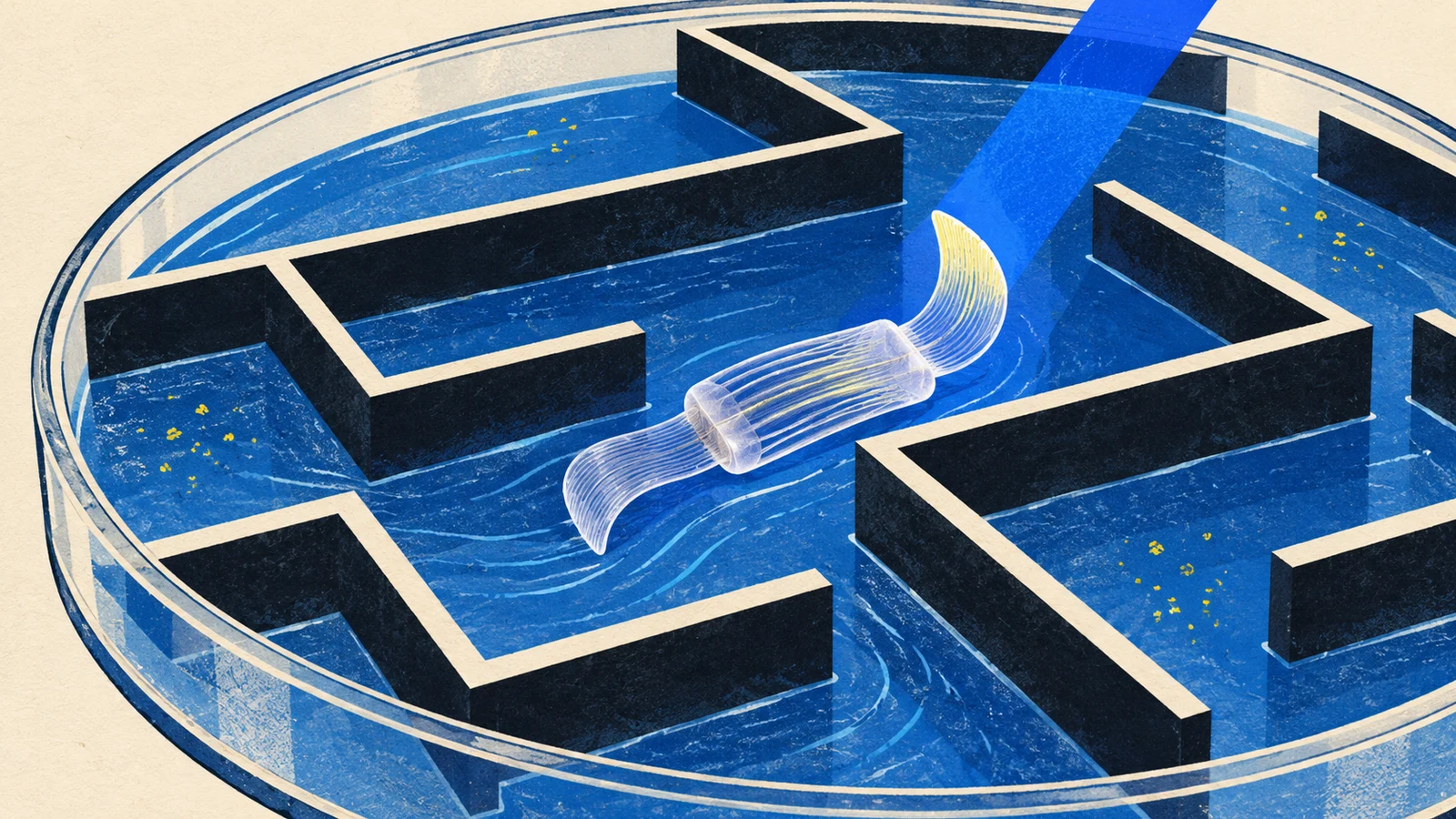
A swimming robot does not necessarily need a motor. In research highlighted by MIT on September 29, engineers used living muscle cells on a thin gel structure to propel a two-finned machine through a water-filled maze. Light provides the control signal: illuminate a fin and its engineered cells contract. The result is a small, steerable swimmer, not an autonomous animal.
The distinction matters. This is an engineering demonstration of how biological tissue can move an artificial structure. It is not evidence that a robot understands a maze, and it is not a miniature submarine ready for a river. The interesting achievement is more specific—and more useful—than either exaggeration.
Give the muscle something worth pulling
MIT describes a design built around gelatin methacrylate, or GelMA. Researchers adjusted the gel’s stiffness and microscopic grooves to support aligned muscle fibers, then used light stimulation to exercise them. A thin support must bend when pulled without simply collapsing or letting the tissue detach. In the demonstration, an operator moved a light source to guide the swimmer through the dish.
The mechanical lesson is easy to miss beneath the living-robot headline: the support is part of the actuator. Thinking only about stronger muscle would overlook the structure that turns a contraction into useful motion. For a machine this unconventional, the seemingly unglamorous material underneath the cells deserves equal billing.
Two impressive numbers, two different meanings
The Advanced Functional Materials paper, first published September 28, reports thin-film actuators functioning for more than 30 days in culture and contractile force per unit tissue volume about 20 times that of previous three-dimensional muscle actuators. That second measurement is force density, not a claim that the complete robot uses 20 times less energy.
Researchers also report swimming speeds reaching roughly four body lengths per minute. But longevity in culture is not nonstop swimming endurance. During a continuous stimulation test, movement slowed, with no measurable translation at 30 minutes. Those are separate experiments answering separate questions.
A useful reading rule follows: ask what sits underneath every impressive multiplier. Is it force, energy, manufacturing cost, operating time or something else? Treating those measures as interchangeable can turn a real laboratory improvement into a product promise the experiment never made.
A remote-controlled swimmer, not a field worker
MIT identifies environmental monitoring as a possible future application and says faster swimming is a next design goal. The current work does not demonstrate a deployed monitoring service. Nor does steering through a prepared maze establish independent navigation in an unfamiliar environment.
That leaves a practical evaluation agenda: how would a future device receive commands, carry a useful sensor, stay functional and be retrieved? Those are questions for subsequent demonstrations, not features to assume from an appealing video. A controlled test can establish a component’s value without answering every system-level question.
TINA’s view
This is worth watching because it treats living tissue as an engineering material with measurable strengths and limits. The attraction is not that biology magically replaces conventional machinery. It is that a different kind of actuator might eventually fit jobs where conventional designs are a poor match. That possibility deserves investigation, not a delivery date.
The strongest counterargument is straightforward: a slow, externally guided laboratory swimmer with fatigue limitations may never become a practical tool. Fair enough. Research need not already resemble a finished product to be valuable, but usefulness must ultimately be demonstrated rather than borrowed from an imagined application.
Our assessment would become more enthusiastic with repeatable tests carrying a useful payload through realistic conditions, alongside clear operating and recovery requirements. It would become less enthusiastic if improved swimming depended on increasingly elaborate external support that erased the intended advantage. For now, watch the next experiment, not a hypothetical launch announcement. This robot has muscle; its job description is still being written.