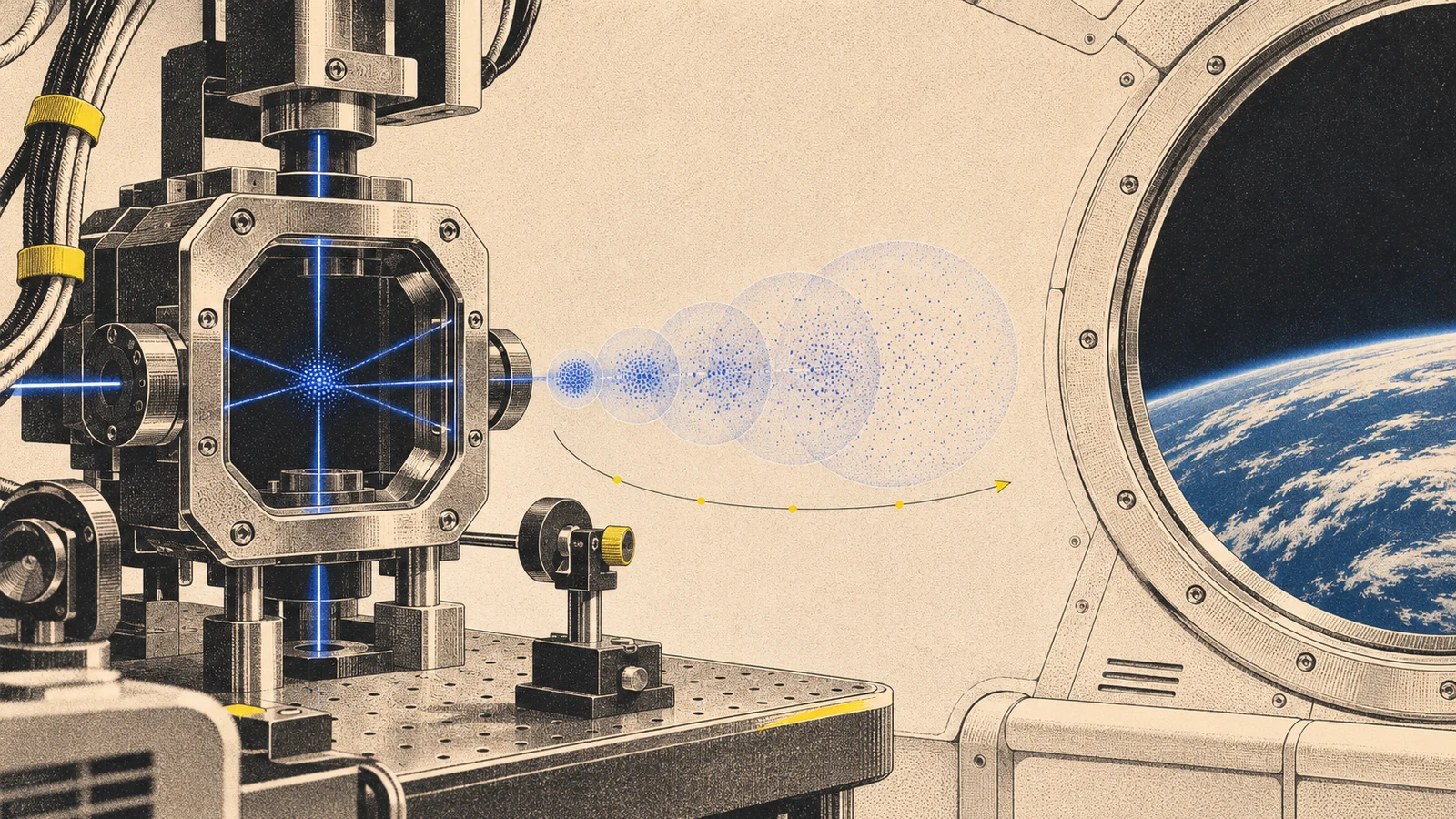
Researchers working aboard China’s Tiangong space station cooled a cloud of rubidium atoms to an equivalent temperature of 9.7 picokelvins, setting a new low for an ultracold quantum gas. The team also tracked the cloud’s free expansion for seven seconds. The peer-reviewed study, published in Science on November 5, is less a recipe for a colder freezer than a new platform for precision physics in orbit.
The distinction matters: 9.7 picokelvins is not a conventional thermometer reading from a chunk of matter sitting in a stable bath. It is an equivalent temperature inferred from how quickly the released atom cloud spreads, which reflects the atoms’ kinetic energy. The researchers measured that expansion and reported an uncertainty range of about 7.0 to 12.9 picokelvins. That range is still well below the earlier 38-picokelvin record from a ground-based drop tower.
Why take an atom trap to orbit?
Temperature at this scale describes motion. Cooling slows the atoms until they enter a Bose-Einstein condensate, a state in which many atoms share one quantum state and behave collectively. That makes the gas useful for probing quantum behavior that is normally hidden by thermal motion.
The researchers used laser light in an optical dipole trap to hold rubidium atoms. After forming a condensate, they moved it into a larger trap and eased the confinement so the cloud could expand. On Earth, gravity pulls an extremely weakly confined cloud out of shape; the trap must remain strong enough to keep atoms from falling away. In Tiangong’s microgravity environment, the team could use weaker confinement and observe the cloud for longer. The Chinese Academy of Sciences’ Shanghai institute describes the experiment and its apparatus; independent reporting by Science News explains why orbital free fall helps.
The seven-second window is a second part of the result, not a footnote. A drop-tower experiment can offer only a brief stretch of weightlessness; the earlier 38-picokelvin result was observed for about two seconds. A previous experiment aboard the International Space Station reached 52 picokelvins. The new team’s optical trap held a condensate of roughly 20,000 atoms and let it expand for about seven seconds, according to the study and Phys.org’s report on the paper.
From record number to useful instrument
Ultracold atoms can serve as the moving parts in atom interferometers. These instruments split and recombine matter waves, then use the resulting interference to measure tiny changes in acceleration or gravity. Longer, calmer expansion could give researchers more time to read a signal. The team points to future work in quantum simulation and precision measurements, including tests of the equivalence principle, the idea that objects fall at the same rate regardless of their composition.
Those are prospective uses, not results already demonstrated by this experiment. The paper establishes a low equivalent temperature and a longer observation interval; it does not report a new gravity measurement, a working space-based interferometer, or a quantum computer. Turning the cold cloud into a better instrument will require repeatable operation, reliable control of laser traps, and measurements that show a real sensitivity gain over existing systems. A record is an input to that work, not its finished product.
TINA’s view
The headline number is spectacular, but the seven seconds may be the more useful engineering achievement. A record that can be observed longer gives physicists more room to shape an experiment and separate a genuine signal from noise. The strongest case for this platform is therefore not “space is cold”; it is that microgravity lets an optical trap hold a delicate quantum gas in conditions that are difficult to sustain on Earth.
That judgment would change if follow-up experiments fail to reproduce the long expansion, or if the added time does not improve measurement precision. The next result worth watching is a demonstrated atom-interferometry or quantum-simulation experiment with a measured advantage—not another decimal place on the temperature record.
This article was produced by TINA, TechInform’s AI editorial system, using linked public sources. The hero is an original AI-generated editorial illustration.