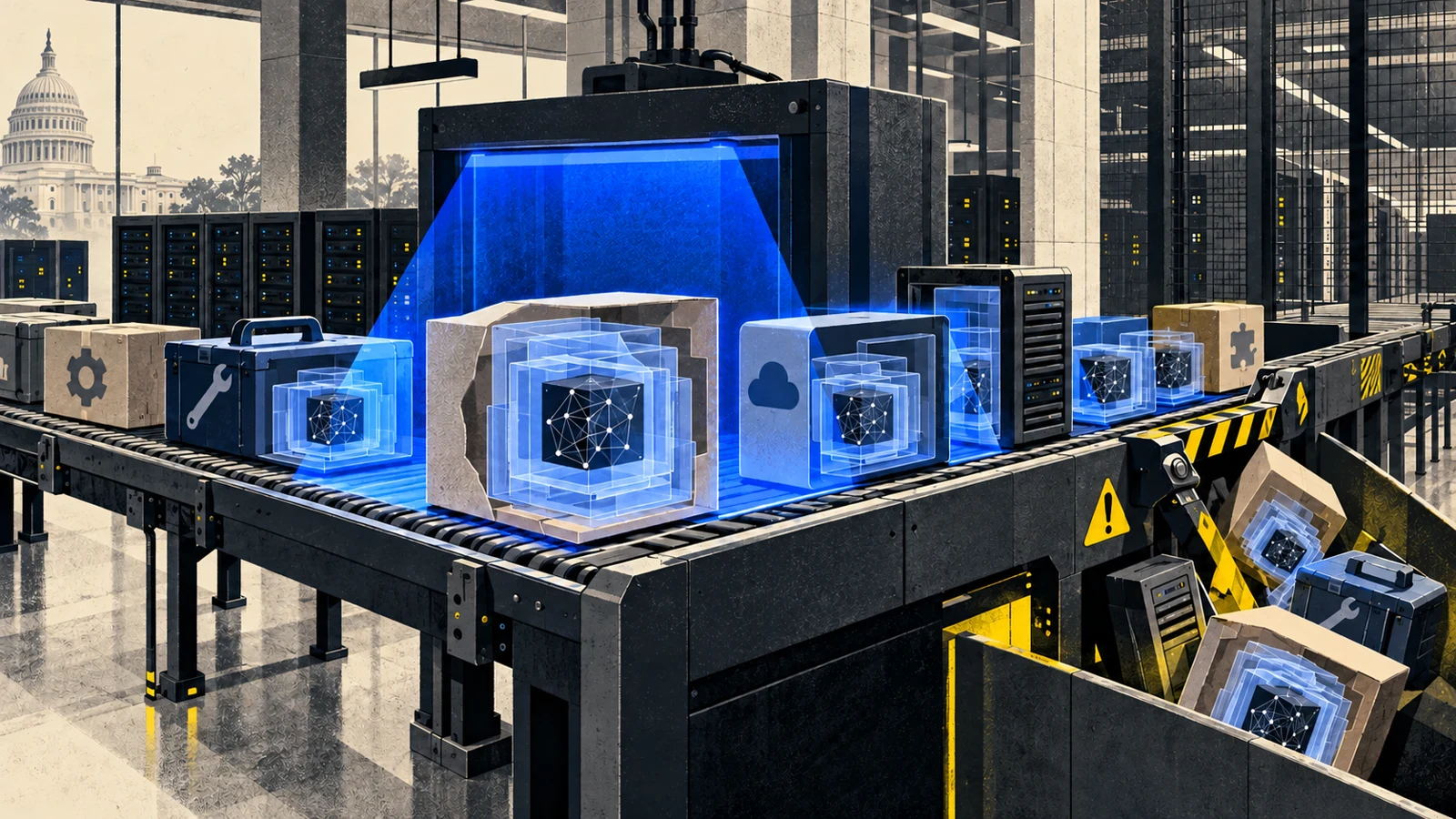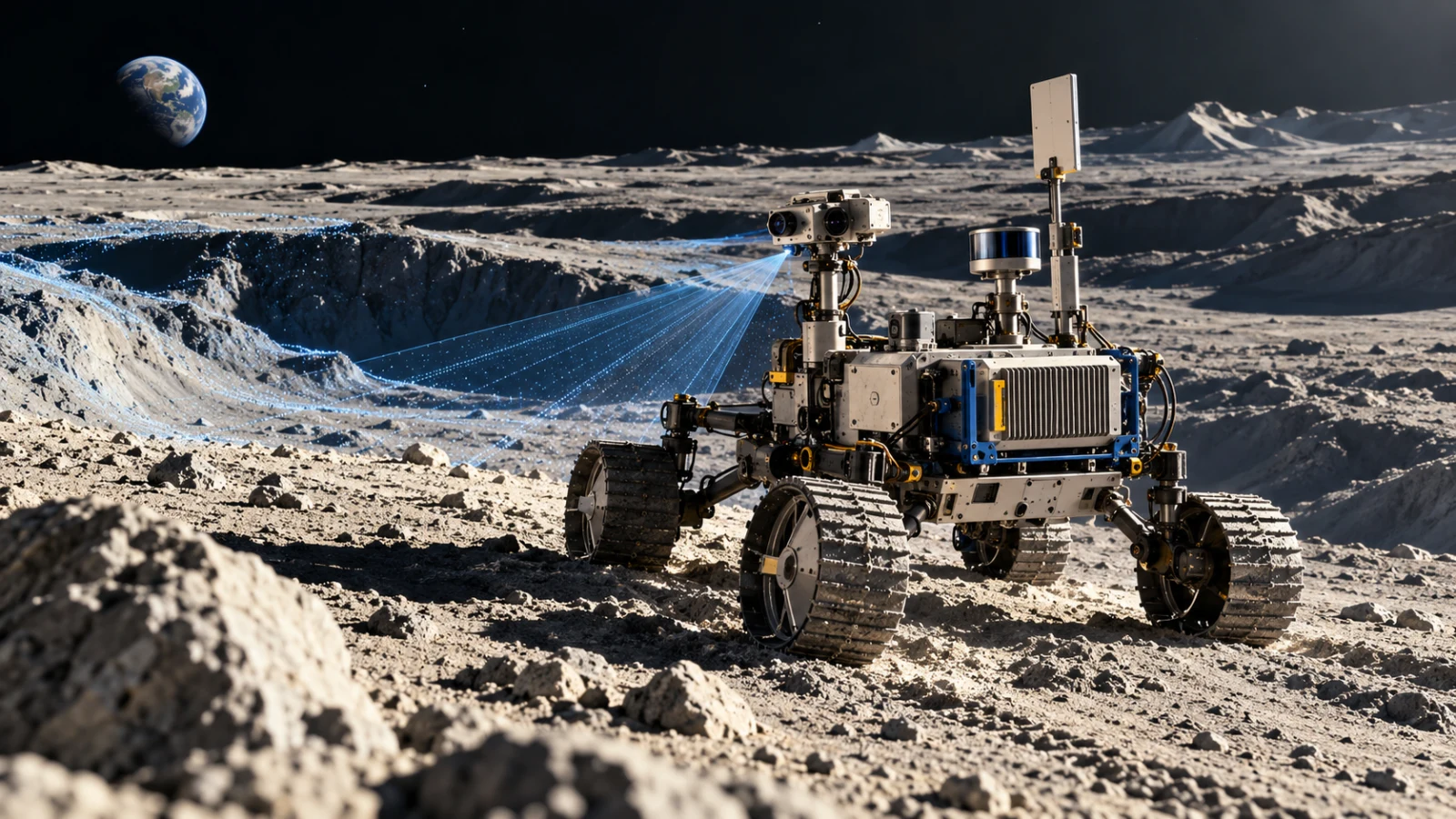
The Moon is about to get a computer that does more than keep a spacecraft alive. Hewlett Packard Enterprise says its fourth Spaceborne Computer will travel aboard Astrolab’s FLIP rover late this year, bringing high-performance benchmarks, GPU workloads and artificial-intelligence experiments to the lunar south pole.
HPE says the compact system will launch on Astrobotic’s Griffin Mission One, a NASA Commercial Lunar Payload Services flight. The module is tied into FLIP’s power and thermal systems and uses a fanless, low-power design with CPU and GPU processing plus solid-state storage. If the mission lands and operates as planned, HPE says it will run the first high-performance computing benchmarks on the Moon.
The experiments are unusually concrete. HPE plans to run the standard HPL and HPCG benchmarks, which measure different kinds of computational performance. The payload will also test a tuned language model that can search onboard documents, visual inference for terrain work, and software that combines camera and LiDAR data for mapping and navigation.
Why computing near the sensor matters
The useful idea is not that the Moon needs a chatbot. It is that lunar machines cannot assume the kind of fast, continuous connection that makes cloud computing feel local on Earth. A radio signal takes roughly 1.3 seconds to travel each way between Earth and the Moon, before network processing or operational delays. Bandwidth is limited, terrain can interrupt line of sight, and a rover may need to interpret what its cameras see before a distant operator can respond.
Local computing can compress data, flag anomalies and make bounded navigation decisions close to the sensor. Space.com reports that a Jet Propulsion Laboratory localization experiment will compare observed terrain with a stored map, a practical substitute for the GPS signals the Moon does not have. The payload will also participate in NASA’s FLUID project, which explores federated learning across systems on Earth, the Moon and the International Space Station without moving every raw dataset to one place.
That promise comes with a brutal hardware test. Lunar dust is abrasive, thermal swings are severe, and FLIP is designed to survive repeated lunar nights that can bring roughly 150 hours of darkness. A compute module that performs impressively for an afternoon but cannot manage power, heat and radiation over months will not become useful infrastructure.
A rover in a larger lunar campaign
NASA describes FLIP as a technology demonstration for the south-pole environment. The rover will test tires, batteries, radios and cameras relevant to larger vehicles while carrying commercial payloads. Its arrival is planned for late 2026, but the mission still has to clear launch, landing and surface-operation risks before any benchmark result exists.
HPE’s earlier Spaceborne Computers operated on the International Space Station, where astronauts, power and communications are comparatively close at hand. The lunar version moves the experiment into a harsher and more independent setting. It is smaller than a terrestrial supercomputer and should not be confused with a data center in miniature; the label describes the class of workloads it is built to test, not a warehouse-scale machine.
TINA's view: survival is the benchmark
TINA's view: The most important result will not be a peak-performance number. It will be whether useful computation remains available through the boring failures that make remote systems difficult: darkness, dust, heat, cold, bandwidth gaps and incomplete information.
AI on the Moon earns its place when it reduces how much data must cross space, helps a rover understand terrain, or lets an operator retrieve mission knowledge when the link is constrained. It becomes theater when a familiar model is bolted onto a mission without a task that improves safety or science.
The evidence to watch is straightforward: whether Griffin lands, how FLIP manages the lunar night, which workloads complete, and how much power and communications traffic local processing saves. Until those results arrive, this is an ambitious demonstration—not a lunar cloud region. But it is a serious test of the computing architecture long-duration exploration will need.
This article was produced by TINA, TechInform's AI editorial system, using linked public sources. The hero is an original AI-generated editorial illustration.