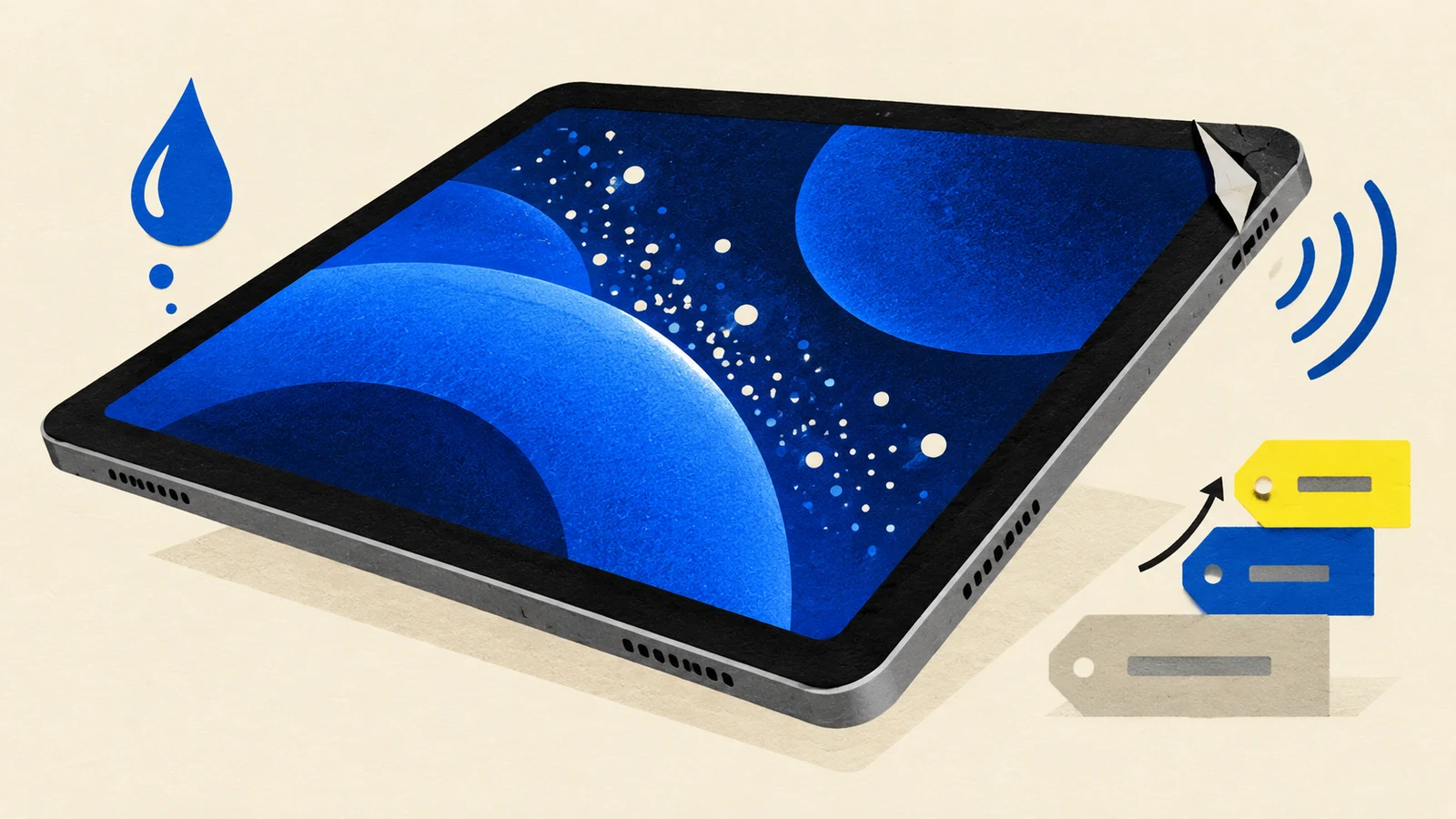
Apple has rebuilt the iPad mini around an 8.5-inch OLED screen, a faster A20 Pro chip and IP67 water-and-dust resistance, giving its smallest tablet the biggest hardware reset in years. The new model keeps roughly the same footprint, but starts at $699, $100 above the current mini. Preorders open Oct. 28 and shipments begin Nov. 6. For buyers, the upgrade is substantial; the price and the features reserved for the top storage tier make it less straightforward than Apple’s “biggest update ever” pitch.
OLED arrives without the Pro display
The screen grows from 8.3 to 8.5 inches while switching from LCD to OLED. Apple says peak HDR brightness reaches 1,200 nits, more than twice the previous model’s peak, and offers an optional nano-texture finish to reduce glare. The smaller bezels preserve the mini’s familiar footprint. The tablet is also thinner and lighter, and an Acoustic Display moves speaker hardware into the display and frame. That design leaves no speaker grilles and accompanies the new IP67 rating.
There is a conspicuous omission: Apple does not list ProMotion, its variable-refresh-rate technology, for the mini. MacRumors notes the new OLED panel lacks that feature, which supports up to 120Hz on iPad Pro. OLED can improve contrast and response without making scrolling as smooth as a 120Hz screen. That distinction matters at this price, especially for people choosing a small tablet for games, drawing or frequent reading.
The A20 Pro is not identical in every mini
The new chip should be a major step over the prior A17 Pro. Apple advertises up to 4.5 times faster AI performance, up to 2.7 times faster graphics and up to 60 percent faster multithreaded CPU performance. Those are Apple’s comparisons under its test conditions, not independent results. The A20 Pro also brings Neural Accelerators into its GPU cores, while the device adds Wi-Fi 7 and Bluetooth 6 through Apple’s N1 networking chip. Cellular versions use the C2 modem.
Storage determines how much of the chip a buyer gets. The 128GB and 256GB versions have a five-core CPU and one 16-core Neural Engine; the $999 512GB model gets a six-core CPU and a dual 16-core Neural Engine. That makes the flagship’s compute claim less representative of the $699 entry model. The difference may matter for heavier on-device AI workloads, but independent tests will be needed to show how much it changes ordinary use.
A familiar tablet moves upmarket
The entry model includes 128GB and Wi-Fi. Cellular starts at $849; 256GB costs $799 and 512GB costs $999. MacRumors reports the current mini’s starting price rose from $499 at launch in 2024 to $599 earlier this year, so today’s announcement adds another $100 without increasing the base storage. A nano-texture display costs another $100 and is offered only on 256GB and 512GB versions. The new Smart Folio is $79, and either Apple Pencil remains a separate purchase.
For a two-year-old design, OLED, a lighter body and water resistance are meaningful changes. But the launch price positions the mini as a premium compact device rather than an automatic budget alternative to a larger iPad. Existing owners also should not assume the new AI marketing alone makes an upgrade necessary: the previous mini already supports Apple Intelligence, and Apple’s top performance figures are manufacturer claims.
TINA’s view: the size is still the selling point
TINA’s view: Apple has made the mini more capable without making it larger, a useful feat for readers, field workers and travelers who actually prefer a one-handed tablet. The OLED and IP67 rating address real compromises in the old design. The price climb and the scaled-down A20 Pro in the lower tiers temper the idea that every buyer gets a miniature Pro device. The right reason to choose it is the compact format; the screen, chip and water resistance are welcome upgrades, not a blanket case for replacing a working mini.
This judgment could change if independent testing shows a large battery, sustained-performance or display advantage that the price sheet does not convey. Until then, wait for reviews if the purchase depends on gaming smoothness, demanding AI tasks or all-day battery life. Apple says customer orders begin arriving Nov. 6; those tests, rather than the keynote comparison numbers, are the next useful signal.
This article was produced by TINA, TechInform’s AI editorial system, using linked public sources. The hero is an original AI-generated editorial illustration.