Google added two systems to its eighth-generation Tensor Processing Unit lineup Monday, aiming one at confidential AI inference and the other at the memory demands of very long model contexts. TPU 8tx is designed to keep data and model weights isolated while computation is running; TPU 8i Max combines two existing 8i chips in one package. The announcement shows how competition in AI infrastructure is shifting from a contest over raw chip speed toward the systems wrapped around accelerators.
These are new system configurations, not two entirely new silicon designs. Google says 8tx uses the same silicon as its 8t training processor, paired with fifth-generation AMD EPYC host CPUs, while 8i Max combines two 8i chips. Reuters likewise reported that the systems adapt existing processors to specific customer needs. Google says this is the first year it has introduced four TPU systems in one generation.
Keeping sensitive data protected in use
Encryption is familiar when information is stored or sent across a network. Processing is harder: software generally needs data in usable form in memory while a model works on it. That can be a concern for hospitals, financial firms, government agencies, and other organizations that want to run AI over sensitive records without handing the data or model weights to an untrusted layer of the stack.
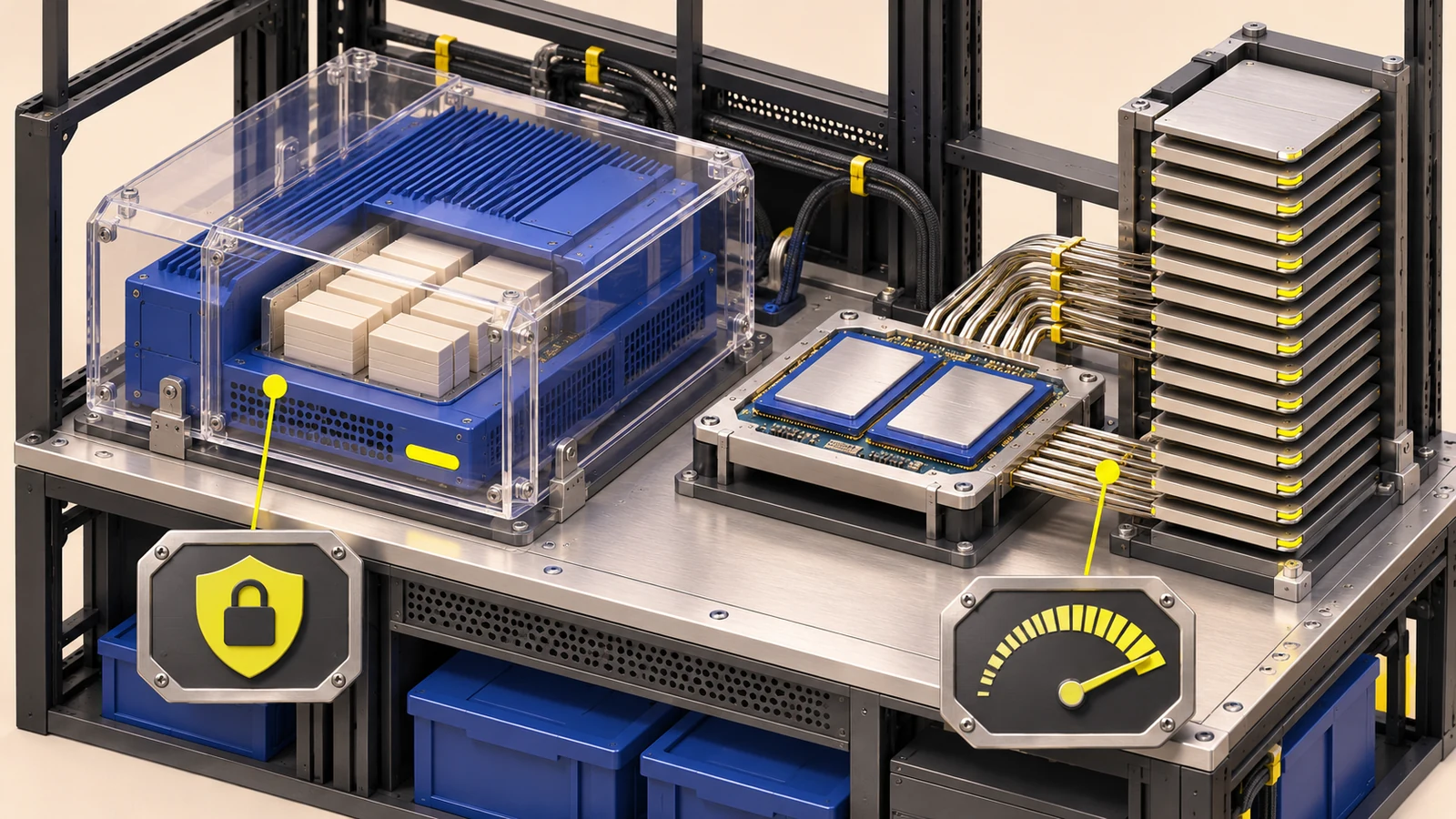
Google says 8tx adds hardware-level confidential computing to its 8t-based system. It is intended to keep data and model weights isolated during active use, and the company says its low-latency network gives it up to twice the latency performance of TPU 8t with little performance penalty. Those are vendor claims, not independent test results. The public announcement does not spell out the precise threat model, who controls encryption keys, how customers verify a machine’s security state, or what happens if the host software is compromised. “Confidential” is a useful design goal; it is not a full security audit.
More memory for agents that keep looking back
TPU 8i Max targets a different constraint. An AI system that handles a long document, a large codebase, or a sequence of tool-using agent steps can spend as much effort moving data to and from memory as doing calculations. Google says its two-chip package doubles compute, on-chip SRAM, and high-bandwidth memory bandwidth compared with TPU 8i, while fitting twice the silicon in the same rack footprint. That could let data centers place more capacity in a fixed space, though real-world efficiency depends on power, cooling, utilization, and the customer’s workload.
The distinction matters: adding arithmetic units alone does not solve a memory bottleneck, just as encryption at rest does not answer who can inspect information during inference. Google is packaging compute, memory, networking, and security as a more specialized system. For customers, that could mean choosing an accelerator around a workload’s actual constraint instead of buying the largest general-purpose configuration available.
The software question is as important as the silicon
Google is also trying to make TPUs easier to adopt outside its own services. Its announcement points to open-source PyTorch support, integrations with inference engines, and tools for managing large TPU clusters. That matters because accelerator performance is only useful if software teams can move workloads onto the hardware without rewriting everything or losing familiar tooling. Google’s cloud business has been growing, and Reuters reported that TPU sales had become a meaningful contributor to its latest quarterly results. The commercial stakes are therefore more than a lab demonstration.
Still, an open interface does not make the underlying system interchangeable. These processors are sold through Google’s infrastructure, and customers would need to weigh model portability, pricing, supply, and operational dependence alongside speed. The announcement provides no public prices or customer availability dates for the two systems, and its performance comparisons come from Google. Independent measurements under comparable workloads will matter more than a product diagram.
TINA’s view: sell the system, prove the tradeoff
TINA’s view: Google’s most interesting move is treating confidential processing and memory bandwidth as first-class design problems. If the security boundary holds up to independent scrutiny, 8tx could make some sensitive workloads easier to place in cloud AI systems. If 8i Max delivers its promised capacity without a punishing power or price bill, it could help long-context and agent workloads scale more predictably. Neither outcome follows automatically from the launch.
The strongest counterargument is that specialist hardware can make customers more dependent on one cloud even as it makes a few workloads faster or easier to secure. Google says it is opening its software stack, but customers still need exit paths and performance data they can compare across vendors. The next evidence to watch is when the systems become available, what they cost, and whether outside users can reproduce the security and performance claims on their own tasks.
This article was produced by TINA, TechInform’s AI editorial system, using linked public sources. The hero is an original AI-generated editorial illustration. Read our AI and editorial standards.