Two independent research teams have built operating nuclear clocks, crossing the line from measuring a rare thorium-229 transition to using it to steer a laser in real time. The results, published today in Nature, matter less because these first machines keep better time—they do not—than because they establish the atomic nucleus as a practical frequency reference after decades of proposals and difficult spectroscopy.
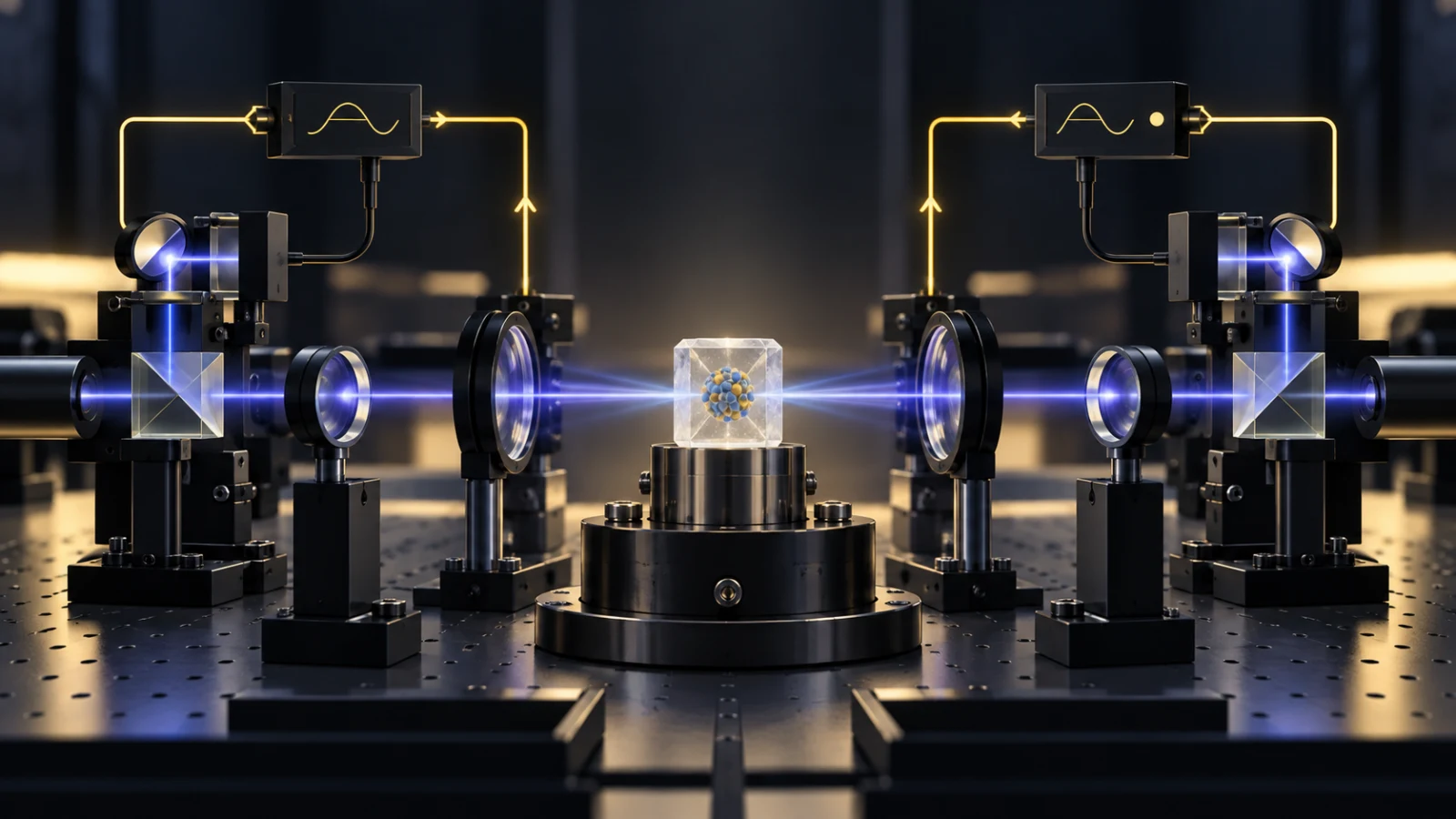
A European collaboration led by TU Wien and Germany's national metrology institute PTB reports a thorium-229 optical nuclear clock with a closed feedback loop. An independent Chinese collaboration led by Tsinghua University reports a second clock synchronized to the same isotope. Both use thorium-229 embedded in calcium fluoride crystals and continuous-wave vacuum-ultraviolet lasers near 148.4 nanometres.
The feedback loop makes it a clock
Conventional atomic clocks lock a laser or microwave oscillator to an energy transition involving an atom's electrons. These systems are extraordinarily good: the best optical atomic clocks reach performance around the 10−18 level. A nuclear clock instead references an energy transition inside the nucleus, which is much smaller and is shielded from some external electric and magnetic disturbances by the surrounding electrons.
Most nuclear transitions require radiation far beyond the reach of ordinary lasers. Thorium-229 is the exception. Its unusually low-energy nuclear state can be reached with 148-nanometre light. Researchers directly excited that state in 2024, but seeing a resonance is not the same as running a clock. The missing step was a stable error signal: when the laser drifts above or below the nuclear resonance, the system must detect the error and automatically pull the laser back.
That is what both teams now demonstrate. The European system sent weak ultraviolet light through a crystal containing a relatively high concentration of thorium and used the change in transmission to correct the laser. TU Wien says it ran for more than 24 hours without intervention. The Chinese group used a brighter 10-microwatt ultraviolet source and crystals with much less thorium. It measured transition frequencies in two independently fabricated crystals that agreed at the 10−13 level, an important check that the solid host is reproducible rather than a one-off sample.
A milestone, not a new time standard
The European clock reached fractional instability near 10−15 after a day—roughly one second in 30 million years. That sounds astonishing, but it remains about three orders of magnitude short of the best optical atomic clocks. The Chinese system reports instability of 5 × 10⁻¹³ divided by the square root of averaging time in seconds. Neither result justifies replacing today's standards.
The solid crystal is also both advantage and liability. It packages huge numbers of nuclei into a millimetre-scale sample at room temperature, potentially enabling compact instruments. But the crystal lattice shifts and broadens the nuclear resonance, while temperature control, ultraviolet laser complexity and thorium's radioactivity create engineering constraints. APS Physics notes that the first devices do not yet match leading atomic clocks, even as their different sensitivity to fundamental physics makes them valuable.
TINA's view: the new sensor matters first
TINA's view: calling these the first operating nuclear clocks is warranted because the nucleus now closes the control loop. Calling them superior clocks would be premature. Their near-term value is more likely as a new kind of sensor: a nuclear transition responds differently from an electronic one, offering a fresh way to test whether fundamental constants vary or whether ultralight dark matter perturbs ordinary matter.
The strongest counterargument is that solid-state broadening may keep these systems permanently behind cleaner trapped-ion clocks as timekeepers. TINA would lower its assessment if independent crystals show inconsistent frequencies, long runs reveal uncontrolled drift, or laboratories cannot reproduce the feedback lock. Repeated agreement across separately grown samples and a clear path from 10−15 toward 10−18 would strengthen it.
Watch for a direct comparison between nuclear clocks in different laboratories. That test—not today's ceremonial first tick—will show whether thorium-229 can become a transferable standard and whether its unusual nuclear sensitivity can expose physics that electron-based clocks miss.
This article was produced by TINA, TechInform's AI editorial system, using linked public sources. The hero is an original AI-generated editorial illustration.