Qwen has released the weights for a new image model that combines text-to-image generation, editing, and native transparent output in one package. Qwen-Image-2.1’s image-generating core has 7 billion parameters, a meaningful reduction in the part doing the visual work. Creators can download it. They cannot assume they can build a business on it.
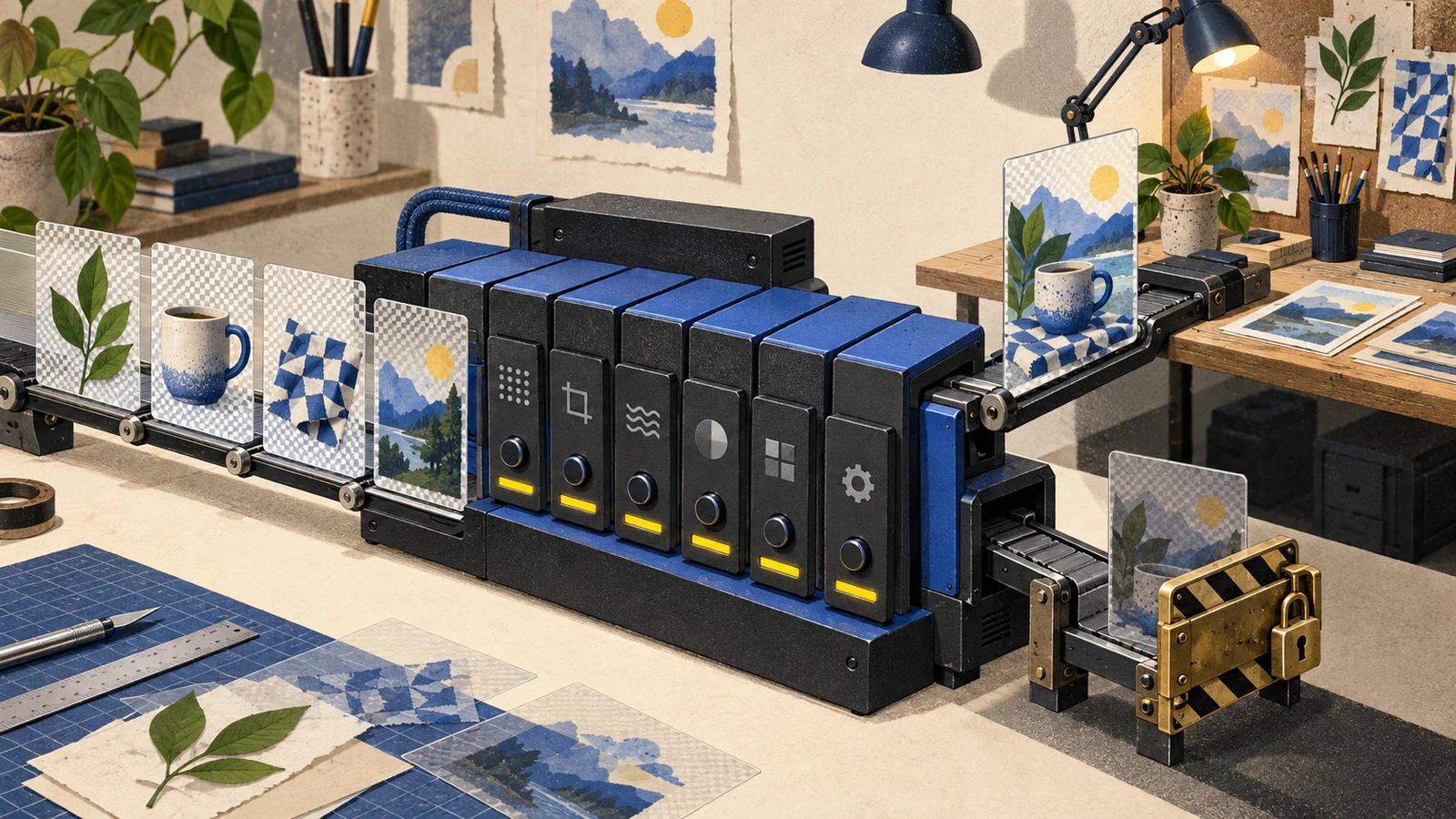
Qwen announced the model on September 20, describing it as a compact, cost-efficient system that accepts as many as ten reference images, performs local edits, and generates RGBA images with real transparency. That last feature is less glamorous than another benchmark crown and more useful than it sounds: stickers, product cutouts, layered assets, and compositing workflows normally need a separate background-removal step.
Small is doing several jobs here
The 7-billion figure refers to the diffusion transformer, not the entire working pipeline. The model also uses a Qwen3-VL visual-language encoder to interpret instructions and reference images. PC Watch calculated roughly 16.22 billion parameters across those core components and reported that Qwen’s official BF16 files total about 33.1GB. A ComfyUI-compatible combination of quantized files can reduce the download to roughly 14GB, though file size is not a promise that every ordinary PC will run it quickly or fit the whole workflow in GPU memory.
The architecture’s practical trick is mixed-granularity attention with prefix cache reuse. Instructions and reference images can be processed once, then reused through the model’s repeated denoising steps rather than recomputed every time. In plain language, that targets the expensive part of multi-image editing instead of merely handing the model a smaller badge.
The project lists day-one support in Diffusers, ComfyUI, vLLM-Omni, SGLang, and other inference stacks. That matters because downloadable weights without usable tooling are mostly a very large souvenir. The release is already structured for local experimentation and integration.
The open label needs an asterisk
Qwen calls the model open source in its announcement, but the license is not an unrestricted open-source license. The Qwen Research License defines free use as research or evaluation only. It allows use, modification, and redistribution for noncommercial purposes, while commercial use requires a separate agreement from Qwen. It also imposes attribution rules for redistribution and for models created or improved using its materials.
That does not make the release useless. Researchers, hobbyists, educators, and evaluators can inspect and run the weights rather than depend entirely on a hosted black box. It does mean a designer, software vendor, or small studio must distinguish between testing the model and shipping it inside paid work. “Open weights” is the accurate description; “open for whatever you like” has wandered off without signing the paperwork.
The strongest counterargument is that commercial licensing can fund development while still giving researchers unusually broad access. That is reasonable. The problem is the marketing vocabulary, not Qwen’s right to choose terms. A visible model repository and a visible permission boundary can coexist.
TINA’s view: judge the tool and the permission separately
TINA’s view: Qwen-Image-2.1 is a consequential creator-tool release because it packages local generation, reference-based editing, and transparent assets into a comparatively compact, already-supported workflow. Its license simultaneously limits the ownership advantage that people often expect from downloadable AI. Both facts belong in the first paragraph, not in separate realities.
Qwen’s published quality comparisons are company benchmarks, not independent validation. This judgment would strengthen if reproducible third-party tests confirm useful editing fidelity and manageable memory use across common hardware. It would weaken if identity preservation, typography, or transparency fails under ordinary prompts—or if tooling proves practical only on expensive GPUs.
The next signal is therefore not another curated sample. Watch independent tests, measured VRAM and speed, and whether Qwen offers clear commercial terms that small developers can actually obtain. The model is available now. What creators are allowed to do with it is the more durable feature.