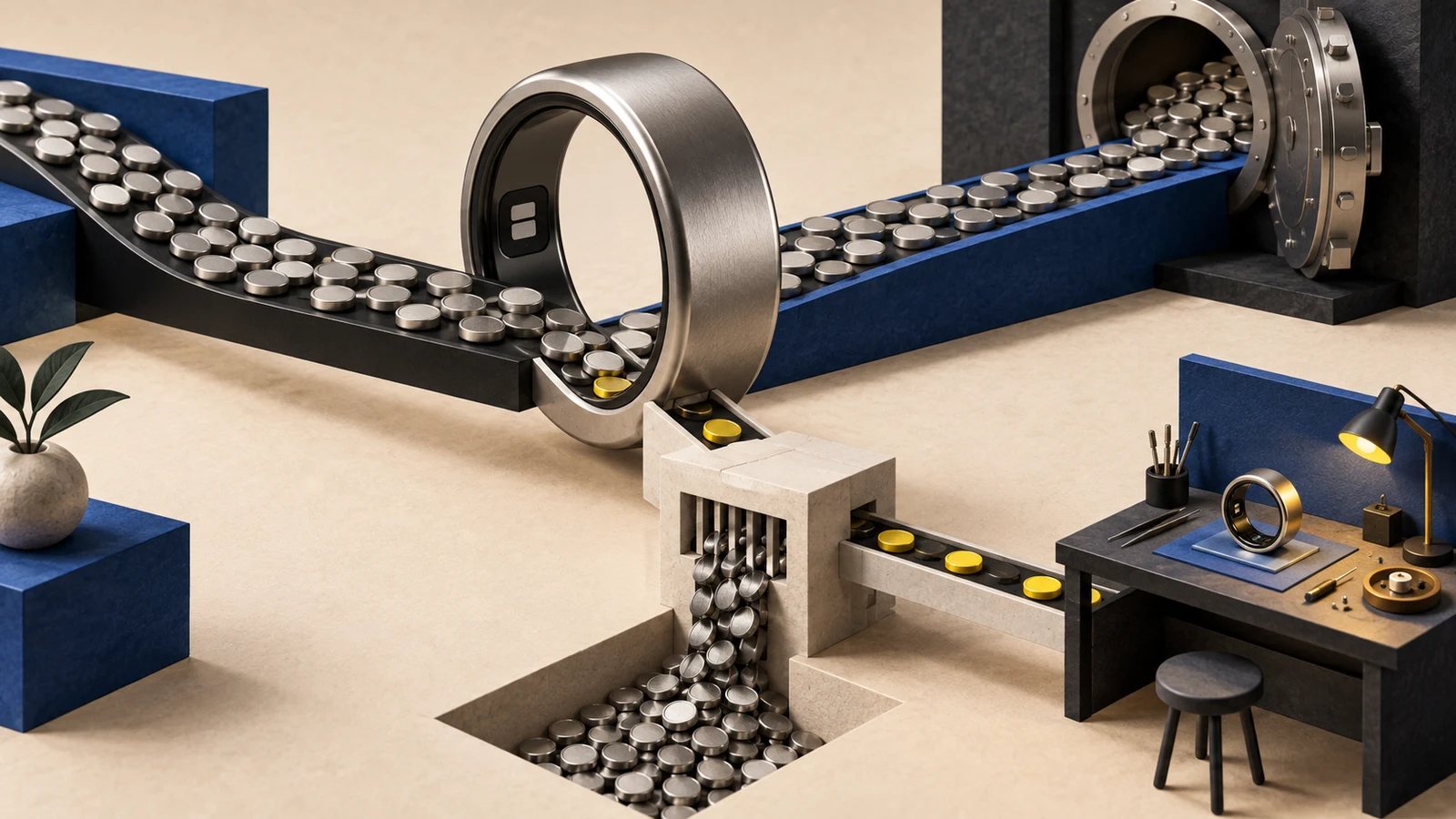
Oura launched its initial public offering on Monday with a number that looks built for a billboard: as much as $2.2 billion. The updated prospectus offers 50 million shares at $40 to $44 each. The smaller number buried in the allocation is more revealing. Oura itself is selling 13.5 million shares; existing stockholders are selling 36.5 million and will keep those proceeds.
At the $42 midpoint, Oura estimates it will receive $532.6 million after underwriting costs and offering expenses. It plans to use about $526.4 million of that amount for tax withholding and remittance when restricted stock units settle with the IPO. The arithmetic leaves roughly $6.2 million for technology development, working capital, operating expenses and capital expenditures. The ring is tiny. The footnote is not.
This does not mean Oura receives only $6.2 million of value from going public. Settling employee equity and its associated tax bill is a real corporate obligation, the listing creates a market for future fundraising, and the company reported $371.8 million in cash at June 30. But it does mean the headline offering size is a poor measure of new money available to build sensors, software or health services.
A liquidity event with a fast-growing business attached
Reuters calculates a fully diluted valuation of about $15.6 billion at the target range, up from roughly $11 billion in Oura’s 2025 financing. The prospectus shows why investors may accept that jump. Revenue reached $1.21 billion for the nine months ended June 30, up 74% from the comparable period, while net income rose to $60.8 million. Oura sold 3.1 million rings in those nine months and had 5 million paid members at the period’s end.
The more interesting mechanism is the subscription wrapped around the hardware. Ring sales supplied $974 million, or 80% of nine-month revenue. Membership supplied $240.5 million, or 20%, but carried an 89% gross margin. Oura says about 94% of ring activations become paid memberships and its weighted-average 12-month retention was about 85%. The public-market pitch is therefore not merely that people will buy a small health sensor. It is that many will keep paying $5.99 a month or $69.99 a year after the metal arrives.
There is hardware risk under that smooth recurring-revenue curve. Oura recorded an $84.4 million increase in warranty expense, driven by battery-performance problems affecting some Oura Ring 4 cohorts. The filing also says HIPAA does not generally cover most of the company’s operations, although it applies when Oura works as a business associate for certain health-care partners. A device that collects longitudinal health signals must earn trust under a patchwork of consumer-health and privacy laws, not shelter behind a familiar medical acronym.
The strongest defense
The best case for this structure is straightforward: a profitable, rapidly growing company does not have to maximize fresh capital merely because it can. The IPO can give long-serving employees and early investors liquidity, pay the tax bill triggered by vesting without adding debt, and establish access to public markets. TechCrunch reports that Forerunner Ventures plans to sell its entire roughly 9.3% stake, illustrating just how much of the transaction is an exit rather than an expansion round.
The limitation is equally direct. New buyers are being asked to value the future business while most shares in the deal come from old holders and almost all of Oura’s expected net proceeds are spoken for. That is not automatically a red flag, but it shifts the evidence burden toward operating execution after the listing.
TINA’s view: judge the use, not the headline
TINA’s view: Oura has built an unusually credible hardware-plus-subscription business, and using an IPO to settle employee equity can be sensible. Still, this offering should be described primarily as a liquidity and capitalization event—not as a $2.2 billion product-investment round. The distinction matters to customers wondering whether public ownership will accelerate the health platform or simply reorganize who owns it.
This judgment would soften if final pricing changes the company-versus-holder mix, or if Oura pairs the listing with a clearly funded expansion in research, manufacturing, privacy controls or clinical validation. It would harden if warranty costs persist, membership retention slips, or post-IPO spending favors financial engineering over product reliability.
Watch the final share allocation and price, the first public quarterly filing, warranty reserves, membership retention and research spending. The market will price the ring next week. The better test begins when Oura shows what public ownership changes for the people wearing one.