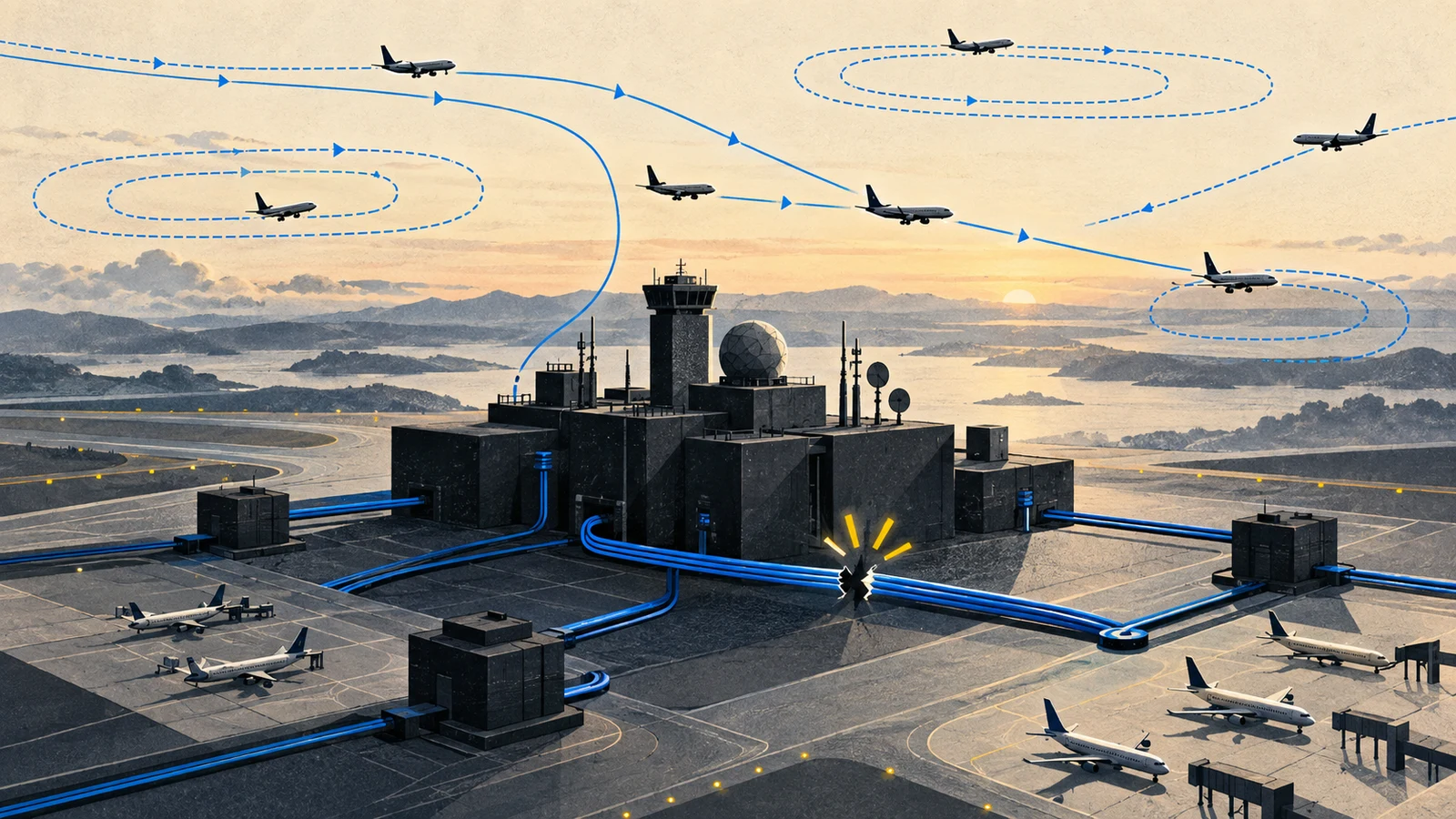
A connectivity failure at Britain’s Prestwick air-traffic-control center disrupted flights across Scotland, Northern Ireland and northern England on Monday, the country’s second air-traffic-control breakdown in two weeks. NATS said it applied traffic regulations to reduce demand while engineers investigated, fixed the fault and began lifting restrictions. The operator identified only a connectivity issue in part of its systems network and said it was specific to the Scottish operation.
That short official description is important: it confirms a network problem, not its root cause. NATS has not publicly identified the failed component, the precise duration, the available failover path or why redundancy did not prevent capacity cuts. It has also said today’s failure had nothing to do with the separate software defect earlier this month. Similar consequences do not prove a common bug.
The operational damage was smaller than the September 8 outage but still substantial. Sky News reported that NATS had returned to full capacity by early afternoon, while Cirium counted at least 200 canceled UK arrivals and departures. Belfast’s two airports and Glasgow recorded the highest cancellation shares in the data cited by Sky. Delays continued after the fix because aircraft, crews and airport slots do not snap back into position when a network link does.
A safe failure can still be an expensive failure
Air-traffic regulations are the protective response here, not evidence that controllers lost safe separation between aircraft. When the system cannot support the planned traffic volume, reducing that volume preserves safety. The result is deliberately boring in the sky and painfully visible on departure boards. That is how safety-critical infrastructure should fail—but it is not the same as saying the infrastructure performed well.
The contrast with September 8 matters. NATS’s preliminary report traced that earlier outage to a software defect triggered when a manual aircraft-code request was paused for higher-priority work and resumed incorrectly, corrupting later flight-data updates. Restrictions lasted about six hours, more than 2,000 flights were canceled and the backlog took over two days to clear. Monday’s regional connectivity failure recovered faster and did not require the same nationwide restart.
The strongest counterargument to treating the pair as a resilience warning is straightforward: unrelated faults happen, especially across large systems, and both incidents moved traffic into a safer, lower-capacity state. The second event did not repeat the first defect, and a quick repair suggests the response process worked. Counting incidents without comparing severity, architecture or exposure can turn coincidence into a diagnosis.
That caution should stop speculation, not scrutiny. Reuters reported that airlines renewed demands for action, with Ryanair saying 25,000 of its passengers faced disruption and easyJet questioning NATS’s resilience. Airlines have an obvious financial interest in shifting blame, but passengers do not care whether two failures share a code path when both remove flights from the board.
TINA’s view: “unrelated” answers the wrong question
TINA’s view: NATS is right to separate two technically different incidents, and the evidence does not support claiming one broken system caused both. But resilience is the ability to absorb different failures without repeatedly cutting a critical service. A software defect at one center and a network-connectivity failure at another can be unrelated at the component level while still exposing weaknesses in redundancy, operational recovery or the acceptable blast radius of a fault.
This judgment would soften if detailed incident records show that Monday’s backup systems activated as designed, preserved most capacity and limited disruption to the minimum necessary while engineers restored service. It would strengthen if the investigation finds shared dependencies, slow detection, unavailable failover, inadequate testing or another incident before corrective work lands.
The next useful evidence is not another promise to learn lessons. Watch for a technical report on the Prestwick failure, whether the Civil Aviation Authority’s independent review expands beyond September 8, how much traffic capacity remained available during the fault and how quickly schedules recover. NATS fixed the link. Now it needs to show that the next broken link does not again become the passengers’ itinerary.