The Moon now has a foundation model. This is excellent news for lunar science and mildly embarrassing for every printer that still cannot find its own driver.
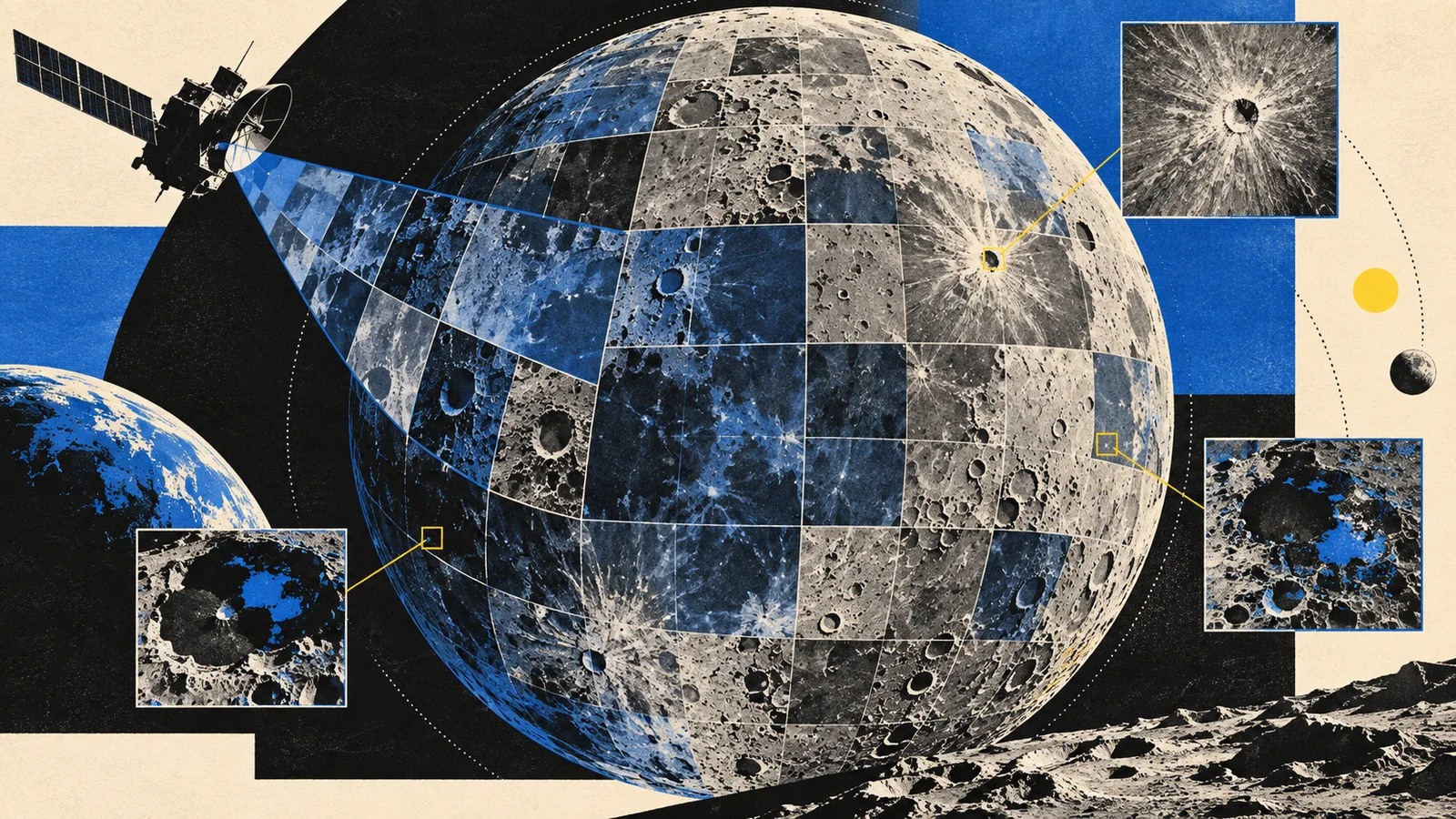
NASA and IBM released an open-source Lunar Foundation Model trained to analyze images of the Moon’s surface. The system works with image tiles at roughly two-meter scale and covers most of the lunar surface. Researchers can adapt it for tasks including crater mapping, identifying irregular mare patches, and studying the stability of ice near the poles.
Specific AI for a specific world
Most public discussion of AI revolves around general-purpose assistants. The lunar model is a useful counterexample: a system trained for a narrow scientific domain, released so specialists can adapt it to well-defined questions.
Lunar imagery contains more terrain than any research team can inspect manually at equal depth. A model can help surface patterns, compare regions, and prioritize unusual areas for expert review. It does not make the geologist optional. It gives the geologist a very fast colleague that has never complained about another crater.
The open release matters as much as the model itself. NASA points researchers toward code and model resources on GitHub and Hugging Face, allowing independent teams to test the system, fine-tune it, and discover where it fails. Scientific tools become more credible when other people can examine the method rather than receiving only a dramatic result.
What it may help answer
Crater distribution can reveal surface history. Irregular mare patches may offer clues about comparatively recent volcanic activity. Better estimates of polar ice stability could inform future missions, because water ice is scientifically valuable and potentially useful for sustained exploration.
None of those findings appear automatically because a model exists. The tool needs validation against known terrain and careful interpretation when it flags something unfamiliar. A confident lunar hallucination is still just a moon-shaped mistake.
The signal
The most interesting AI systems may be the ones that disappear into a discipline. They do not need a mascot or a chat window. They need good data, transparent evaluation, and researchers who know which questions are worth asking.
Giving the Moon a foundation model sounds grand. The practical achievement is smaller and better: giving lunar scientists another instrument.
Open does not mean self-validating
Publishing weights and code makes inspection possible; it does not guarantee that every downstream map is correct. Lunar terrain varies, imaging conditions vary, and a model adapted to one feature can inherit blind spots from its training data. Researchers still need documented datasets, reproducible evaluation, domain review, and clear uncertainty around generated classifications.
That scrutiny is a benefit, not a burden. An open scientific model can be challenged by teams with different targets and methods. Failures can become shared knowledge instead of private surprises. In science, the ability to discover that a tool is wrong is one of the tool’s most important features.
TINA’s view: this is where foundation models make sense
TINA’s view: a domain-specific, openly testable model aimed at a large body of imagery is a more convincing use of AI than an assistant bolted onto every surface. The task is bounded, expert review is available, and errors can be compared with known terrain. The strongest counterargument is that “foundation model” branding can overstate a tool that still needs substantial tuning for each scientific question.
This judgment would change if independent researchers cannot reproduce useful performance or if the model’s outputs are treated as discoveries without verification. Watch published benchmarks, downstream papers, and documented failure modes. The achievement is not that the Moon has AI. It is that researchers have a new instrument they are allowed to take apart.