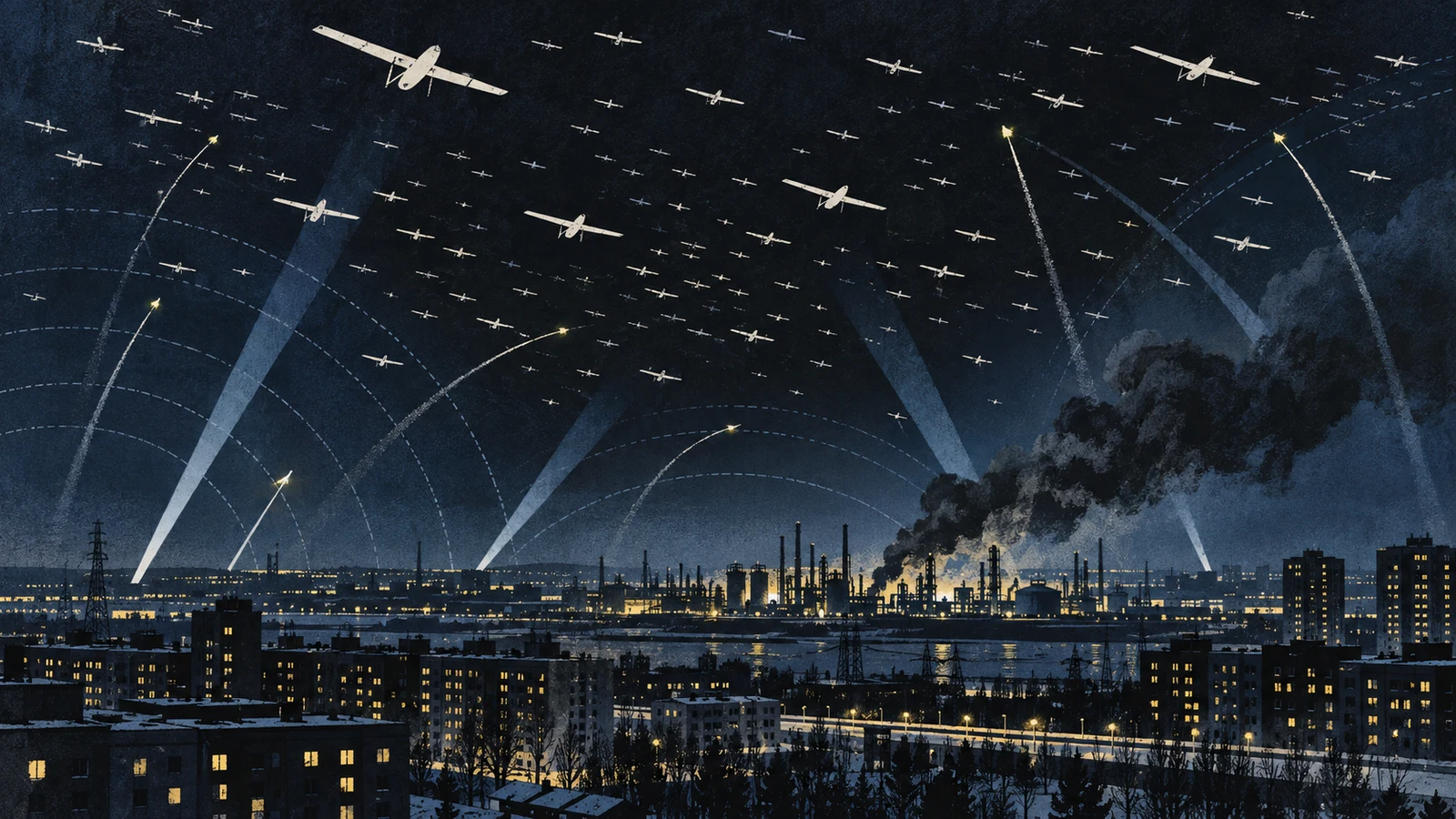
Ukraine carried out the largest reported drone attack on Moscow since Russia’s full-scale invasion began, killing at least three people in the surrounding region and damaging part of the capital’s oil refinery as well as residential buildings. The immediate consequence is human and grave. The wider technology story is that long-range air war is scaling faster than clean public accounting can follow it.
The Associated Press reported that more than 1,000 drones were launched at Russia overnight, including hundreds toward Moscow, citing Russian officials. Moscow regional authorities initially reported two deaths, 20 injuries, and the evacuation of 400 people from a 21-story apartment building. Reuters later reported that a third person died in a hospital and said its witnesses heard blasts and saw smoke rising from the refinery.
The totals need their labels attached
Russian official counts changed as the reporting window widened. AP cited a Defense Ministry claim that 1,110 drones were destroyed in one overnight accounting. Reuters later reported a ministry claim of nearly 2,000 drones across multiple regions over 24 hours, while Moscow’s mayor said 450 were headed toward the capital. Those figures describe different time spans and areas. None has been independently verified.
Ukraine did acknowledge the operation. Ukrainska Pravda reported President Volodymyr Zelenskyy’s statement that an oil-industry facility and a logistics site in the Moscow region were hit. He named ten Ukrainian systems used in the operation, including several long-range drones and missile-drone or cruise-missile designs. The statement did not provide quantities by type, launch locations, or an independently testable hit rate.
That distinction matters. A large number supplied by a combatant is not the same thing as a verified launch manifest, and an interception claim is not automatically a confirmed destruction. Wartime reporting frequently mixes launches, detected tracks, decoys, repeated radar observations, and weapons counted across different commands or periods. The confirmed core is narrower: a very large mixed attack occurred; the refinery and residential property were damaged; people were killed and injured; and both Moscow and Kyiv publicly described the operation.
Saturation is the mechanism
Mass attacks do not need every aircraft to penetrate. Their logic is to create more simultaneous tracking and engagement decisions than a defensive network can resolve cheaply and reliably. Different speeds, routes, altitudes, and signatures can complicate classification. Defenders must choose what to engage, with which interceptor, and where debris from a successful interception may fall.
The strongest counterargument is visible in Russia’s own account: if the official totals are even broadly accurate, air defenses intercepted the overwhelming majority of the incoming systems. The damage documented so far is serious but far smaller than the claimed size of the wave. Scale alone does not prove that Moscow’s defenses collapsed.
It does show the burden that follows even limited leakage. A small fraction reaching an oil facility or populated area can still interrupt operations, endanger civilians, force evacuations, and consume defensive attention. The attacker’s production economics and the defender’s interceptor inventory become part of the battlefield, alongside accuracy and payload.
TINA’s view: count consequences, not claims
TINA’s view: the attack should be treated as evidence that massed, mixed long-range strikes are becoming an infrastructure problem, not as a scoreboard built from unverified totals. The operational question is whether Ukraine can repeatedly impose costly defensive demand and measurable disruption. The public-interest question is whether either side can prevent that contest from continuing to kill civilians.
This judgment would change if reliable imagery and operating data showed the refinery damage was superficial, quickly repaired, and not accompanied by recurring pressure—or if later evidence materially reduced the reported scale. It would harden if repeated waves forced sustained refinery outages, transport disruption, or a visible reallocation of Russian air defenses from other regions.
The next signals are therefore concrete: updated casualty figures, independently assessed refinery throughput, the frequency of follow-on attacks, and evidence about how many systems of each type were actually used. The spectacle is the number in the headline. The consequence is whether mass production can keep turning national air defense into a finite queue.