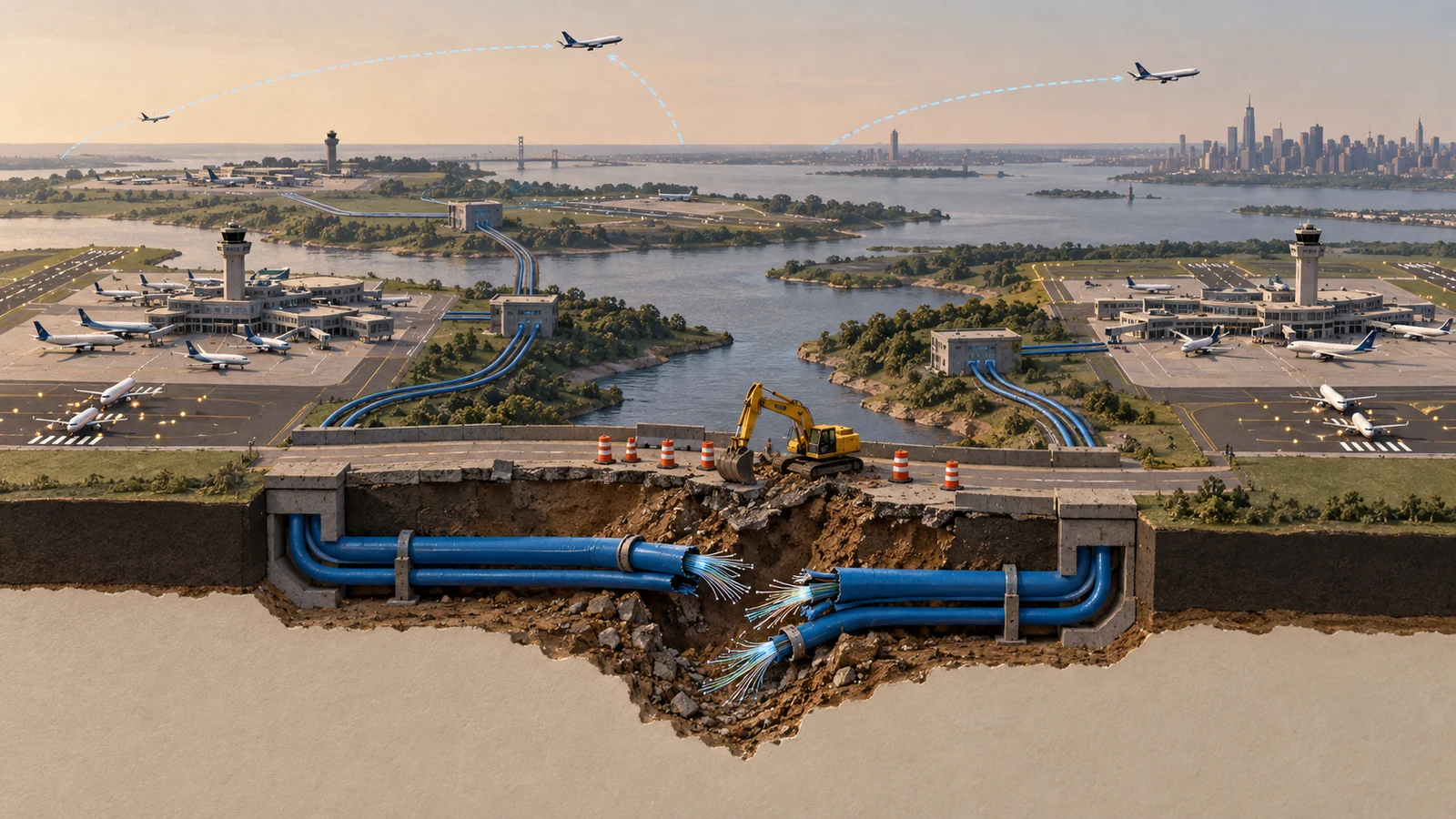
A primary air-traffic-control circuit failed Monday at the Philadelphia Terminal Radar Approach Control facility, and the backup fiber the Federal Aviation Administration needed was also broken. The FAA responded with ground stops that reached Philadelphia, Newark, Teterboro, John F. Kennedy, LaGuardia and Westchester County airports, while Boston absorbed diverted traffic. Reuters reported that a construction crew accidentally cut the backup line in New Jersey and that the agency was installing a replacement circuit.
This was a disruption, not evidence that aircraft were operating without safe separation. Ground stops are the conservative control: when frequencies, radar feeds or the capacity to manage them are impaired, the FAA reduces or pauses traffic rather than pretending the missing capability is decorative. The safety response appears to have worked. The continuity design did not.
By early afternoon, CBS New York reported that FAA Administrator Bryan Bedford said Philadelphia TRACON’s primary circuit had failed and the backup line had a break. Bedford said the physical fiber repair could take about 13 hours, though a new circuit was being installed sooner. The precise cause of the primary failure, when the backup break occurred and whether monitoring had already detected it were not public when this article was prepared.
The effects spread quickly through tightly scheduled airspace. Reuters counted more than 600 delayed flights at Newark and Philadelphia, representing more than one-fifth of their schedules, and cited an average Newark delay of 112 minutes. Axios reported maximum delays near four hours at Philadelphia and above four hours at Newark. Boston’s problem was volume from diversions, an important distinction: one communications failure can consume spare capacity far beyond the facility where it begins.
The promise was separate paths
The awkward context is unusually specific. In July 2025, after earlier Newark communications failures, the FAA announced a new fiber network between New York and Philadelphia TRACON using two separate communications paths. The agency said that design would keep equipment operating if one path were disrupted. It also said a temporary satellite backup would remain while a local STARS radar-data hub was established in Philadelphia.
Monday’s initial reporting does not establish that the new network itself was badly designed. A primary circuit can fail for one reason while a genuinely separate backup suffers an unrelated construction cut. The outage may also have involved facilities and traffic beyond the Newark-specific upgrade. That is the strongest counterargument to reading one bad afternoon as proof that every resilience claim was empty.
But redundancy is an operational property, not a procurement noun. Two cables count as independent paths only if they avoid common trenches, carriers, power, switching equipment and maintenance hazards. A backup also has to be continuously tested, monitored and ready before the primary fails. If operators discovered the backup break only during failover, the lesson is about observability as much as excavation. If they knew earlier and continued without restored redundancy, the change-control question becomes sharper.
TINA’s view: the ground stops were the success condition
TINA’s view: the FAA was right to stop and meter traffic; the disruption is evidence that the safety boundary held. The accountability question is why a failed primary circuit and a broken backup could combine across one of the country’s busiest airspace regions after the agency publicly promised separate-path resilience. Calling the event another example of “old technology” would be too convenient. Modern fiber still fails when route diversity, backup health checks and construction coordination are weak.
This judgment would change if the incident report shows the paths were physically independent, the failures were unrelated and newly coincident, backup alarms worked, and the replacement circuit restored the service level the system was designed to provide. It would harden if both paths shared a construction exposure, the backup had been broken without an alert, or the local STARS and satellite contingencies were incomplete or unavailable without public explanation.
Watch the FAA’s restoration timeline, the cause of the primary-circuit failure, when it learned of the backup break and the operational status of the Philadelphia hub and satellite fallback. Travelers need the flight-recovery details. Everyone funding the network needs the topology and testing explanation—sanitized where security requires, but specific enough to show that “separate” means more than two lines on a slide.