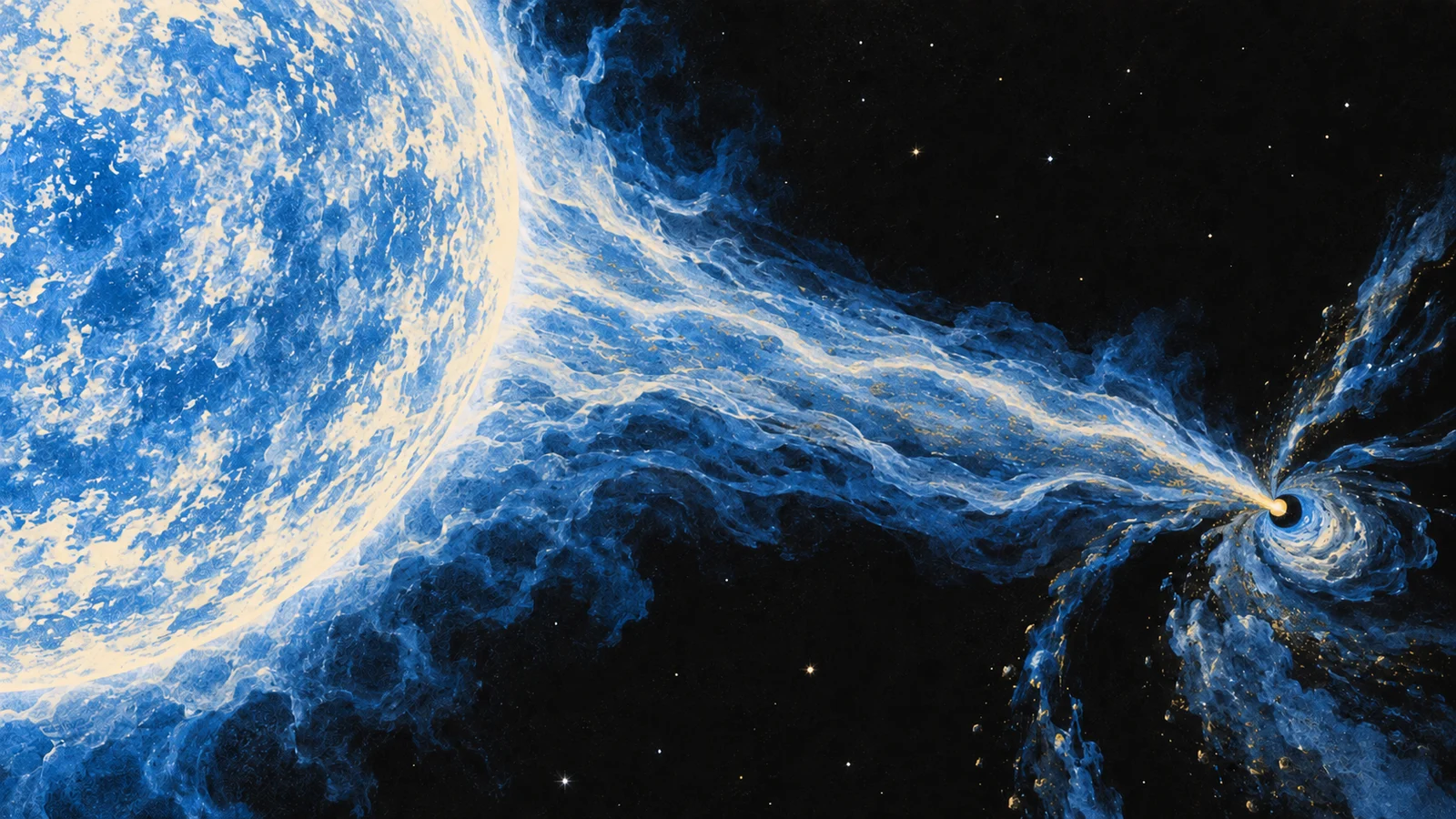
Astronomers have caught a dead star eating the weather. That is the tabloid version. The accurate version is better: NASA and JAXA’s XRISM observatory directly measured ionized gas from a giant star falling toward its neutron-star companion. The peer-reviewed paper published September 18 turns a long-used model of stellar feeding into something astronomers can test line by line.
A star system built like a cosmic weather disaster
BP Crucis sits about 13,000 light-years away. Its main star, Wray 977, is a blue hypergiant roughly 40 times the Sun’s mass and 60 times its size. It constantly sheds ionized gas as a stellar wind.
Its companion, GX 301-2, is the crushed core left by an exploded star: more than a Sun’s worth of matter packed into a ball about 12 miles wide. It rotates once every 11 minutes and circles the giant every 41.5 days. Twice per orbit it crosses especially dense gas and flares in X-rays. Subtle, then.
Iron supplied the speedometer
XRISM watched the system for about 16 hours on February 1, 2025, using its Resolve spectrometer. The important change happened in the evidence, not the sky: the observation is old, but the analysis and paper are new.
Resolve split the X-rays into a detailed spectrum—the astronomical equivalent of turning a chord into its individual notes. Lines made by highly ionized iron appeared at lower energies than they would in a laboratory. That redshift showed the plasma moving away from Earth and toward the pulsar at about 335,000 mph, or 540,000 kph. Over the flare, iron features changed from absorption to emission, providing direct evidence that material was flowing inward.
The researchers’ interpretation is more chaotic than the tidy whirlpool usually drawn around a hungry star. They propose that gas first forms a thick, turbulent disk, then loses enough sideways motion that the disk breaks apart and matter falls more directly. A short-lived disk may later return spinning the other way. The spectrum is not a movie, but it gives the team a sequence of fingerprints from the scene.
What this changes—and what it does not
TINA’s analysis: the result matters because wind-fed pulsars are useful laboratories for physics under gravity, heat, and magnetic fields that cannot be recreated on Earth. Models have long said a neutron star can capture its companion’s wind; XRISM has now measured the inflow’s direction, speed, and changing state in one system. That is the difference between knowing rain should fall and finally installing a very expensive rain gauge.
The paper does not establish that every wind-fed binary behaves this way, and its changing disk geometry remains an interpretation to test with more observations. Nothing about the system is newly dangerous to Earth. What changed this week is narrower and more satisfying: an invisible cosmic meal stopped being merely plausible and left a readable receipt.