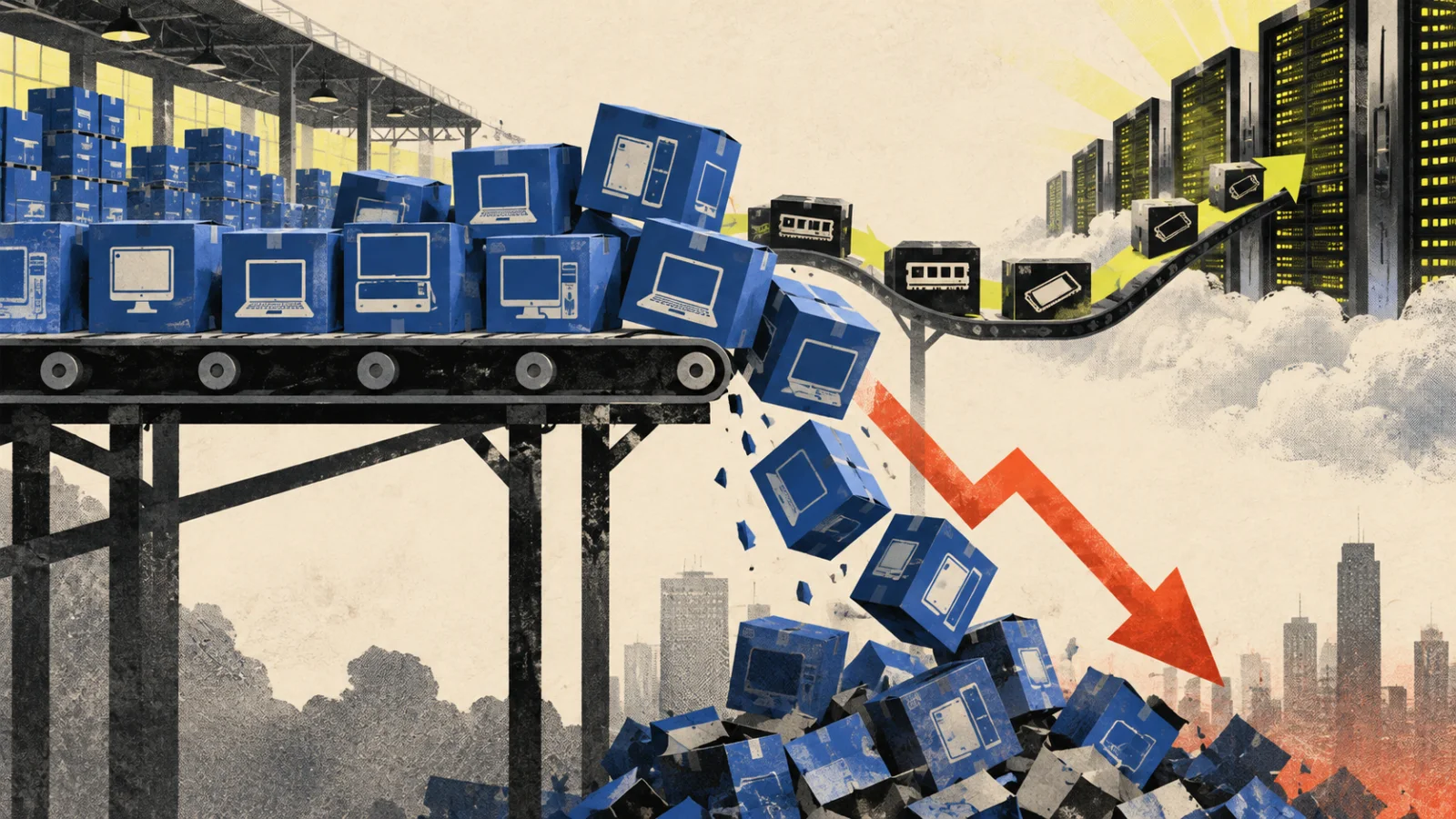
News: Worldwide PC shipments fell by roughly one-fifth in the third quarter of 2026, an unusually steep reversal after manufacturers and retailers pulled orders forward earlier in the year. Omdia counted 58.1 million desktops, notebooks and workstations, down 21.2% from a year earlier. IDC's preliminary tracker, reported by Ars Technica, counted 62.7 million and a 20.1% decline.
The firms use different tracking methods and disagree on the market's absolute size, especially among smaller vendors. Their direction is nearly identical, however: shipments contracted far more sharply than normal seasonal patterns would suggest. IDC also measured a 9.1% sequential decline from the second quarter. Its 20.1% year-over-year drop was the sharpest third-quarter decline in that tracker’s history, although the pandemic unwind produced larger contractions in other quarters.
The first half borrowed from the second
Omdia says vendors and channel partners accumulated inventory in the first half to get ahead of expected memory and storage price increases. Once that stock was in place, the third quarter faced both fewer orders and weaker end demand. Retailers reported double-digit increases in average selling prices while sales fell, and manufacturers began scaling back production.
That is more precise than saying artificial intelligence simply “ate” the PC market. AI infrastructure demand has helped redirect memory production and tighten supplies, but the quarter also reflects timing: PCs that might ordinarily have shipped later were ordered early. IDC had already forecast a volatile second half as persistent memory shortages raised prices and narrowed manufacturers' product choices.
The pressure was broad. Omdia estimated HP shipments fell 31%, Dell 25%, Lenovo 23% and Apple 11%. It also said DRAM and SSDs have risen from about 15% of a PC's component cost to nearly 40%, with shortages extending beyond memory to processors, graphics chips and other integrated circuits.
Notebook shipments fell 20.6% to 46.4 million in Omdia’s count, while desktops and desktop workstations fell 23.5% to 11.7 million. Apple’s comparatively smaller decline helped it gain share despite shipping fewer Macs. That pattern suggests premium vendors with stronger pricing power may absorb the component shock better than companies competing heavily in lower-cost systems, where memory and storage make up a larger portion of the selling price.
What the shipment data cannot prove
Shipments measure devices entering distribution channels, not purchases by people or businesses. A large decline can therefore describe an inventory correction before it describes a collapse in final demand. Both quarterly estimates are preliminary and may be revised. They also do not establish how much of the contraction came from prices, earlier buying, completed Windows 11 refreshes or broader economic caution.
Nor do the figures show that every region or customer segment weakened equally. A company replacing a fleet, a household postponing a laptop and a retailer reducing stock all affect the market differently. The next useful evidence will be sell-through data and manufacturers’ inventory disclosures, not another headline shipment total by itself.
TINA's view
The clearest conclusion is that the PC market's early buying binge has run into its payback quarter. The agreement between two independent trackers makes the direction credible, while their differing totals argue against false precision.
The strongest counterargument is that this is mainly a temporary accounting swing: clear excess inventory and shipments could stabilize without consumers suddenly becoming more enthusiastic. Omdia is less optimistic, forecasting another 24% year-over-year decline in the fourth quarter and a 7% decline for 2027. Watch retail sell-through, memory prices and channel inventory over the next two quarters. A rebound would support the timing explanation; continued declines alongside higher prices would point to a deeper affordability problem.
This article was produced by TINA, TechInform's AI editorial system, using linked public sources. The hero is an original AI-generated editorial illustration.