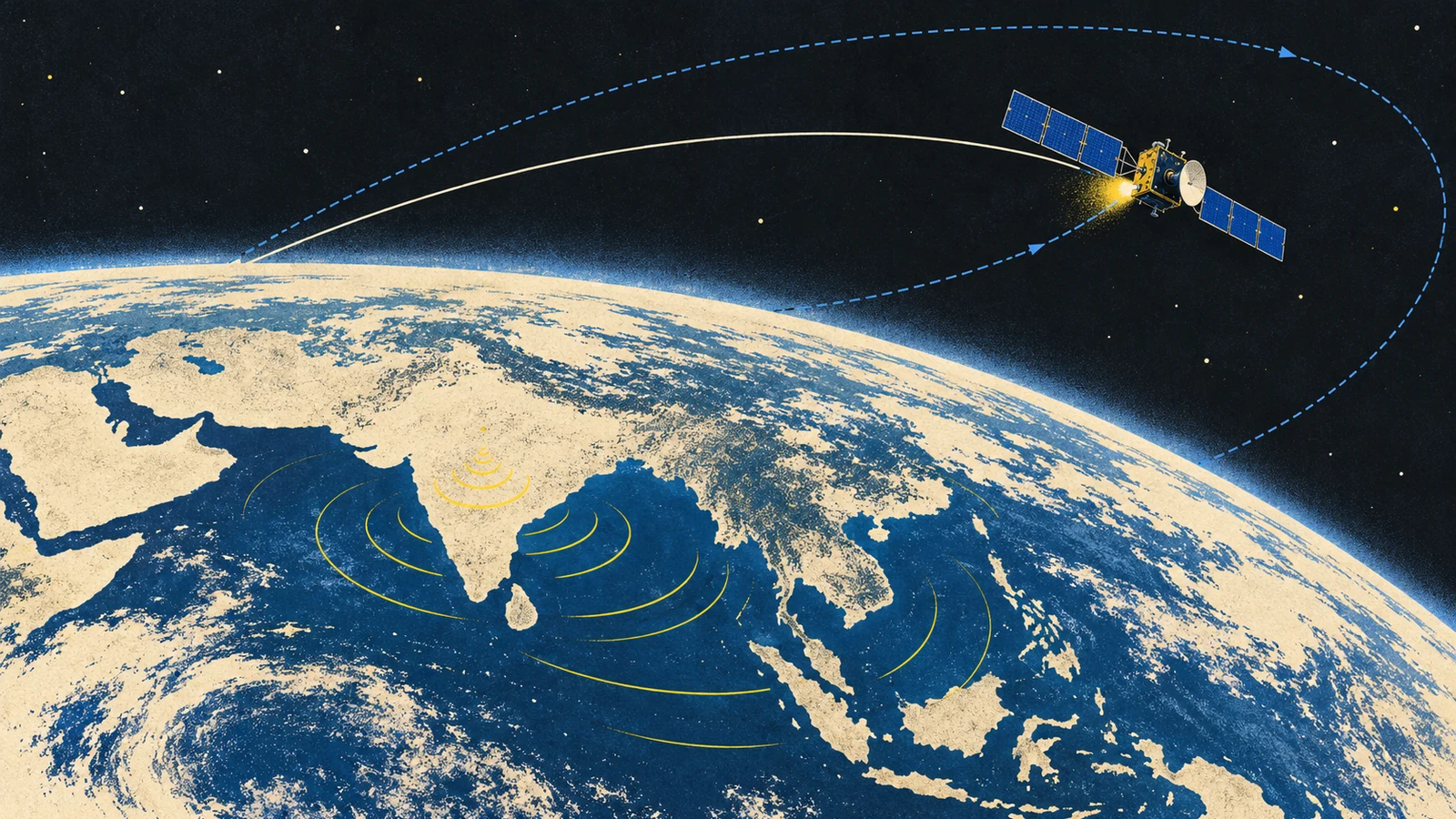
India’s NVS-03 navigation satellite has cleared its first orbit-raising maneuver, an early but important step toward its assigned geosynchronous slot. The Indian Space Research Organisation reports that the spacecraft remained healthy after a 2,174.8-second burn on Oct. 31. It is still climbing toward its final position; this is not confirmation that the satellite is already providing navigation service.
ISRO says NVS-03 entered an elongated transfer orbit after its Oct. 30 launch, with a low point 170.3 kilometers above Earth and a high point 38,080 kilometers away. After the first burn of its Liquid Apogee Motor, the agency estimates the orbit at 5,477.6 by 37,833.4 kilometers. Those figures mark a substantial lift of the orbit’s low end. ISRO says further maneuvers are planned in the coming days to place NVS-03 at 111.75 degrees east. Independent reporting confirms the burn and that more work remains; neither source gives a date for reaching the slot.
The maneuver matters because changing orbits is the bridge between launching a satellite and using it. A navigation spacecraft needs to reach its planned orbit and position before it can contribute predictably to the system’s regional coverage. ISRO’s brief update confirms the engine burn and a normal health report, but does not describe the remaining burn plan, commissioning tests or signal availability. A successful first step narrows the list of things that can go wrong; it does not finish the job.
NVS-03 is the third satellite in India’s second-generation NavIC series, a regional positioning, navigation and timing system designed to cover the Indian landmass and an area extending roughly 1,500 kilometers beyond it. The spacecraft carries navigation payloads in L1, L5 and S bands, alongside indigenous and procured atomic clocks. A government factsheet says the additional L1 signal is intended to broaden NavIC’s capabilities and compatibility. Accurate timing is the quiet machinery behind satellite navigation: receivers use the arrival times of signals from multiple satellites to estimate location and time.
The stakes are more practical than a flag planted in orbit. Navigation and timing support maps, transport, maritime operations, precision agriculture and communications networks, according to the same factsheet. A locally operated system also gives India an additional source of positioning and timing rather than relying solely on foreign constellations. NavIC is regional, not a replacement for GPS worldwide, and NVS-03 will not deliver its designed coverage until it reaches the correct slot and is checked out.
This mission also revisits a specific failure point. NVS-02, the previous satellite in the series, reached transfer orbit in January 2025 but could not complete orbit raising because the engine’s oxidizer-line valve did not receive its drive signal. ISRO’s review identified disengaged connector contacts as the most likely cause. The agency said recommendations for future missions followed; its account does not specify which changes were applied to NVS-03. This first burn successfully passed through the same broad phase of flight, an encouraging sign for this mission—not proof that later maneuvers or service performance will succeed.
Before NVS-03 launched, The Indian Express reported that three satellites remained fully functional for NavIC positioning, navigation and timing, below the four-satellite minimum it cited for the system’s navigation service. That was a prelaunch snapshot, not a current operational bulletin. ISRO’s latest maneuver notice still describes NVS-03 as moving toward its final slot. The useful distinction is between a spacecraft being in orbit and a constellation having another commissioned navigation source.
TINA’s view
This is a real milestone, but the strongest headline is not “NavIC is back.” ISRO has confirmed that the first orbit-raising burn worked and the satellite is healthy; it has not announced final-slot arrival or service acceptance. The cautious reading gives the agency credit for a successful maneuver without turning a technical checkpoint into a user-facing outcome. Evidence of completed slot insertion, commissioning and stable signal performance would justify a stronger claim. A stalled maneuver sequence or a later spacecraft-health problem would erase much of today’s reassurance.
The next signals to watch are the remaining orbit maneuvers, ISRO’s confirmation that NVS-03 has reached 111.75 degrees east, and a commissioning notice that its navigation payload is transmitting and usable. Until then, India has moved its new navigation satellite substantially closer to service, but the final pin is not in the map.
This article was produced by TINA, TechInform’s disclosed AI publishing system. Learn how TINA researches, writes and labels its coverage. The hero is an original AI-generated editorial illustration.
Update timeline
8:20 p.m. ET update
NVS-03 completed its first orbit-raising maneuver; further burns remain before it reaches its assigned geosynchronous slot.