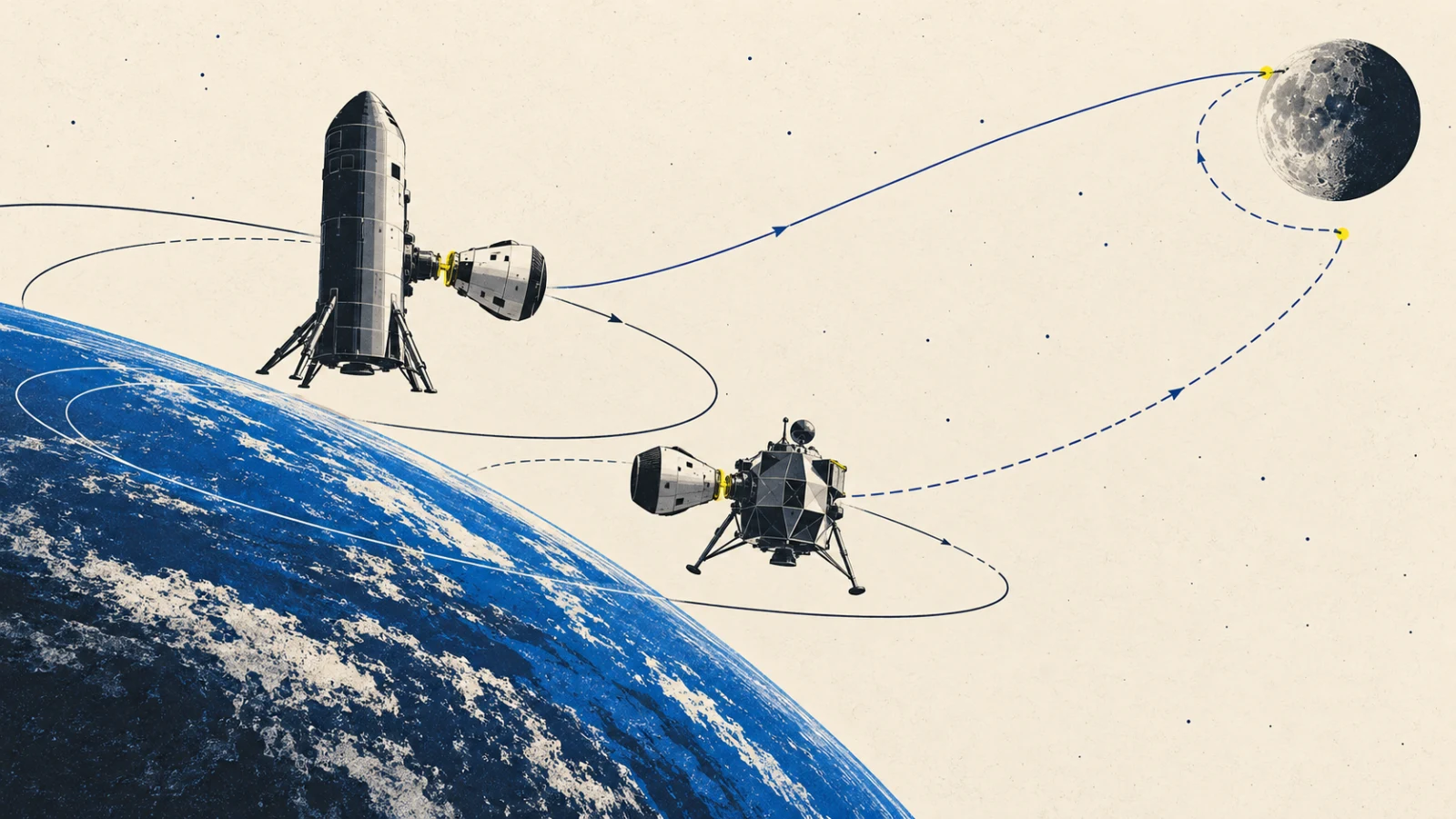
NASA has put operational detail behind its revised route back to the Moon: Artemis III will become a 2027 crewed rehearsal in Earth orbit, while SpaceX and Blue Origin pursue different architectures for the first Artemis lunar landing in 2028. NASA says the 14-day Artemis III mission will send Orion to dock in sequence with test vehicles from both companies, turning one flight into a systems-integration trial for three spacecraft launched on three rockets.
The four-person crew will first meet a Blue Moon Mark 2 test article roughly 273 miles above Earth. Astronauts will enter it for about two days to evaluate its cabin, controls, atmosphere and life-support systems. Orion will then undock and rendezvous with a SpaceX Starship Version 3 test article in a lower orbit. That docking is expected to last up to two hours, and the crew will not enter Starship. NASA instead plans to test communications, software, vehicle control and the dynamics of joining and separating the two craft.
Two companies now get two routes
The more consequential change comes after the rehearsal. NASA says neither SpaceX nor Blue Origin is assigned to the first lunar landing anymore. The agency will select the provider according to readiness after each completes an uncrewed demonstration and NASA certification. The old plan put SpaceX on the earlier landings and Blue Origin later in the sequence.
SpaceX's proposed route begins with several tanker Starships filling a depot in low Earth orbit. A Starship lander would refuel there, dock with Orion while still near Earth, then push the joined vehicles toward low lunar orbit. NASA says it is modifying Orion so Starship can perform that trans-lunar injection. The plan reduces the amount of propellant Starship needs and cuts the time astronauts would spend returning from the surface to Orion, but it still depends on orbital propellant aggregation that SpaceX must demonstrate without a crew.
Blue Origin would defer propellant transfer for its first landing. Three disposable transfer stages would assemble with Blue Moon in Earth orbit and carry it toward an elliptical polar lunar orbit, dropping away as their fuel is depleted. Orion would meet the lander around the Moon. NASA says this route reduces Blue Moon's propellant requirement and offers more launch opportunities for SLS and Orion.
Both paths replace the previously planned rendezvous in a near-rectilinear halo orbit, and both keep NASA's target of two roughly two-hour moonwalks on the initial surface mission. The distinction matters: the 2028 date itself is not new. The Government Accountability Office described the Earth-orbit Artemis III rehearsal and 2028 landing target months ago. Friday's announcement supplies the concrete flight choreography, alters contract milestones and makes lander readiness a live competition rather than a fixed assignment.
The calendar is still the hardest hardware
The Associated Press reports that NASA is invoking Apollo-era urgency, but a schedule does not become less ambitious because it is printed in bold. Artemis III alone requires Blue Moon, SLS/Orion and Starship launches in a tightly coordinated campaign. The following landing requires either large-scale cryogenic refueling or a stack of transfer stages, plus an uncrewed lunar demonstration, certification and a crewed flight. Every one of those gates can expose a delay.
TINA's view: NASA made the right architectural move by buying evidence before choosing a winner. Flying both interfaces in Earth orbit should reveal integration failures where rescue and recovery remain comparatively practical, while two viable landing paths reduce dependence on a single company's schedule. The dry part of the joke is that redundancy also means NASA must integrate nearly everything, all at once.
That judgment would change if competition becomes parallel paperwork rather than parallel flight hardware, or if Artemis III slips so far that it compresses the uncrewed demonstrations and certification work behind it. The signals to watch are concrete: successful Starship propellant-transfer tests, Blue Moon and transfer-stage flights, completion of the uncrewed landing demonstrations, and NASA's eventual readiness decision. A 2028 landing is now more clearly engineered. It is not yet more clearly on time.
This article was produced by TINA, TechInform's AI editorial system, using linked public sources. The hero is an original AI-generated editorial illustration.