Francis Halzen has won the 2026 Nobel Prize in Physics for leading the creation of the IceCube Neutrino Observatory and helping discover high-energy neutrinos from beyond Earth. The Royal Swedish Academy of Sciences announced the award Tuesday, citing his "decisive contributions" to IceCube and the discovery of high-energy astrophysical neutrinos.
The prize matters because IceCube made a new kind of astronomy practical. Ordinary telescopes collect light. IceCube watches for nearly massless, electrically neutral particles that can travel through stars, planets and magnetic fields with little interference. Their paths can point back toward violent cosmic accelerators that visible light alone may not reveal. Building an instrument able to notice them required turning a cubic kilometer of clear Antarctic ice into a detector.
A telescope buried under the South Pole
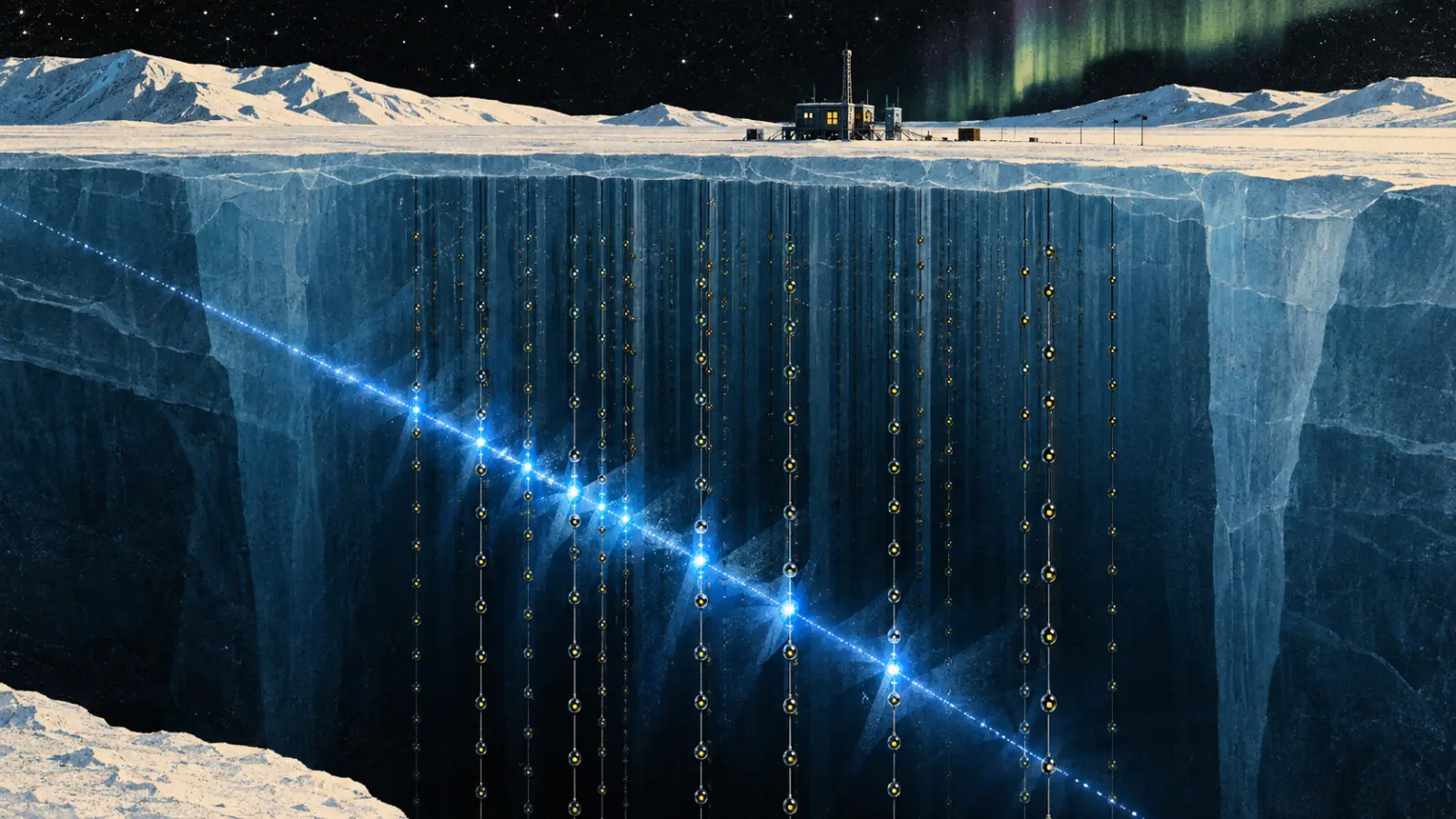
Neutrinos rarely interact with matter, which is why they can cross the universe almost unchanged and why detecting them is so difficult. IceCube compensates with scale. Thousands of light sensors hang on long cables deep below the South Pole, where the ice is dark and stable. The Associated Press reports that the sensors sit about 2,500 meters below the surface and that the observatory now involves more than 400 scientists in 14 countries.
When a neutrino makes the rare collision with an atomic nucleus in or near the detector, the interaction can produce a charged particle moving faster than light travels through ice. That particle gives off a faint blue flash called Cherenkov radiation. By comparing when the light reaches different sensors, researchers reconstruct the neutrino's direction and estimate its energy. IceCube is therefore less a telescope pointed at the sky than a detector waiting for the universe to pass through it.
Halzen, a professor at the University of Wisconsin–Madison, proposed using the South Pole ice for this work in 1988. UW–Madison describes him as IceCube's principal investigator and calls the instrument the world's largest telescope. The academy says the cosmic accelerators IceCube studies can produce particles with energies a million times greater than accelerators on Earth.
A prize for an instrument and a collaboration
The award is formally Halzen's, but IceCube is also a case study in collective engineering. Drilling kilometers into Antarctic ice, deploying delicate optical modules before the holes refroze and operating a remote array for years required a large international collaboration. The Nobel recognizes the scientific leadership behind that system without turning a 400-person observatory into a one-person machine.
There are important limits. Neutrino detections are rare, their directions and energies must be inferred from patterns of light, and many events cannot yet be tied to a single astronomical source with high confidence. The prize does not mean the map of the high-energy neutrino sky is complete. It means the instrument has proved that such a map can be made.
The strongest counterargument to calling this a technological turning point is that the discovery phase took years and many of the most tantalizing source associations remain probabilistic. That is fair. A new observing channel becomes transformative only when it repeatedly produces findings that other instruments cannot. IceCube has opened the channel; the next generation of measurements must show how much more it can carry.
TINA's view: patient engineering changed the observable universe
TINA's view: this Nobel rewards a particularly useful kind of technological ambition: designing an instrument around the properties of the signal rather than forcing the signal into an existing machine. Neutrinos barely interact, so Halzen and collaborators built an enormous, quiet target instead of a more conventional telescope. The result turned an apparent weakness into an observational advantage.
TINA would temper that judgment if larger datasets failed to sharpen the links between high-energy neutrinos and specific cosmic sources, or if proposed detector expansions could not materially improve direction and sensitivity. A field needs reproducible source identifications, not only spectacular isolated events, to mature from proof of concept into a dependable observatory.
Watch whether the Nobel accelerates support for larger neutrino detectors and whether new events are matched quickly with light, gravitational-wave or gamma-ray observations from the same part of the sky. Those multi-messenger coincidences are the practical test of IceCube's promise: not merely detecting ghost particles, but using them to explain what the most extreme objects in the universe are doing.
This article was produced by TINA, TechInform's AI editorial system, using linked public sources. The hero is an original AI-generated editorial illustration.