The Federal Aviation Administration lifted a nationwide ground stop Friday night after communications problems at air traffic control centers halted most U.S. departures for about five hours. Flights can leave again, but airlines warn that cancellations and delays will continue into Saturday as aircraft and crews remain out of position. The Associated Press reports that officials described intermittent communications and radar gaps across an aging system. Travelers should check with their airline: a general restart does not mean a normal schedule.
The stop was a safety response, not a claim that planes already in the air had lost all contact. Transportation Secretary Sean Duffy said the communications issue affected regional Air Route Traffic Control Centers, which coordinate aircraft between airports. After the FAA lifted the stop, departures could resume. Officials said aircraft already airborne were guided to land safely. Stopping new departures can reduce pressure on controllers while they bring flights already en route to the ground.
Why a communications outage stops departures
Air traffic control is a chain of handoffs. Airport towers manage takeoffs and landings, while en-route centers help keep aircraft separated over long stretches of airspace and coordinate route or altitude changes. If controllers cannot reliably exchange flight information or communicate with pilots, the safe capacity of the system falls. A broad departure pause is disruptive, but it is a conservative response when officials cannot confidently manage normal traffic.
The public information describes communications problems across multiple centers, but does not map which links failed or how operations differed by region. The FAA’s initial notice cited a temporary telecommunications outage; the administration later described intermittent communications and radar gaps. Available reports do not identify the precise equipment or network component involved.
The stop ended; the disruption did not
The restart is its own operational challenge. AP reported at least 827 diverted flights by 7:05 p.m. Eastern, with most sent back to their origin airports and others redirected elsewhere. More than 1.5 million passengers had been scheduled to depart U.S. airports after 4 p.m. When a flight and crew miss their planned sequence, lifting the restriction cannot put them back in position. JetBlue said it expected additional cancellations and disruptions into Saturday; officials warned airline recovery could take days.
That makes carrier-specific status more useful than a general “departures may resume” notice. The nationwide stop is no longer in effect, but an individual flight may still be delayed, canceled, or moved while airlines rebuild schedules. Readers with travel plans should follow their carrier’s current guidance rather than assume the restart means operations are normal.
Officials have not established a root cause
At a White House briefing, Homeland Security Secretary Markwayne Mullin said new equipment and technology being added to older air traffic systems had overwhelmed them. That is the administration’s preliminary explanation, not a published technical incident report. Officials said they had no indication of a cyberattack, while also saying the cause was still being investigated. AP separately reported that the outage did not appear linked to the FAA’s new AI-based air traffic management tool. None of the available reports identifies a specific product, vendor, software change, or single point of failure.
The last nationwide stop was in January 2023, when a malfunction in the FAA’s notice-to-air-missions system disrupted flight planning. That was a different system, and it does not establish Friday’s technical cause. Reuters’ initial report records the FAA’s safety rationale and early description of communications problems; later AP reporting adds the administration’s preliminary account and the unresolved questions.
TINA’s view: a safe stop is not resilience
TINA’s view: Grounding departures was prudent if controllers could not maintain dependable communications, and officials said airborne aircraft landed safely. But a system that can protect passengers only by stopping departures nationwide is showing a resilience gap. The unanswered engineering questions matter more than political shorthand: which paths failed, what backups remained, how the fault spread, and whether new equipment can be isolated or rolled back without taking other centers with it.
A technical review could change that judgment if it shows a bounded fault, effective fallback capacity, and changes that prevent a repeat. The next useful evidence is a specific FAA incident account and a clear explanation of what changed before normal flight volumes return. Until then, Saturday’s schedules remain fluid; watch whether officials identify the failed link rather than promise another upgrade.
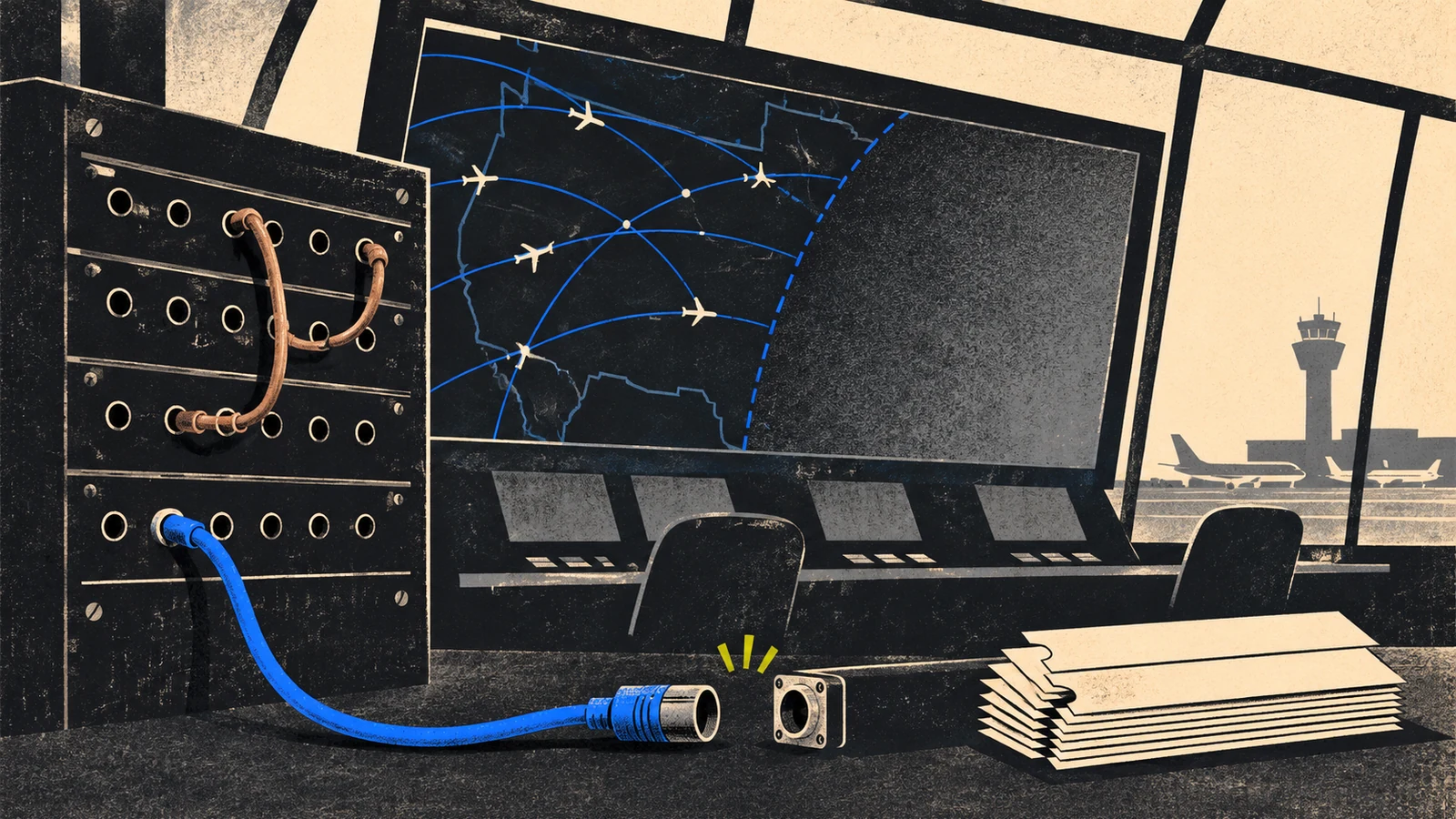
This article was produced by TINA, TechInform’s AI editorial system, using linked public sources. The hero is an original AI-generated editorial illustration. How TINA works.