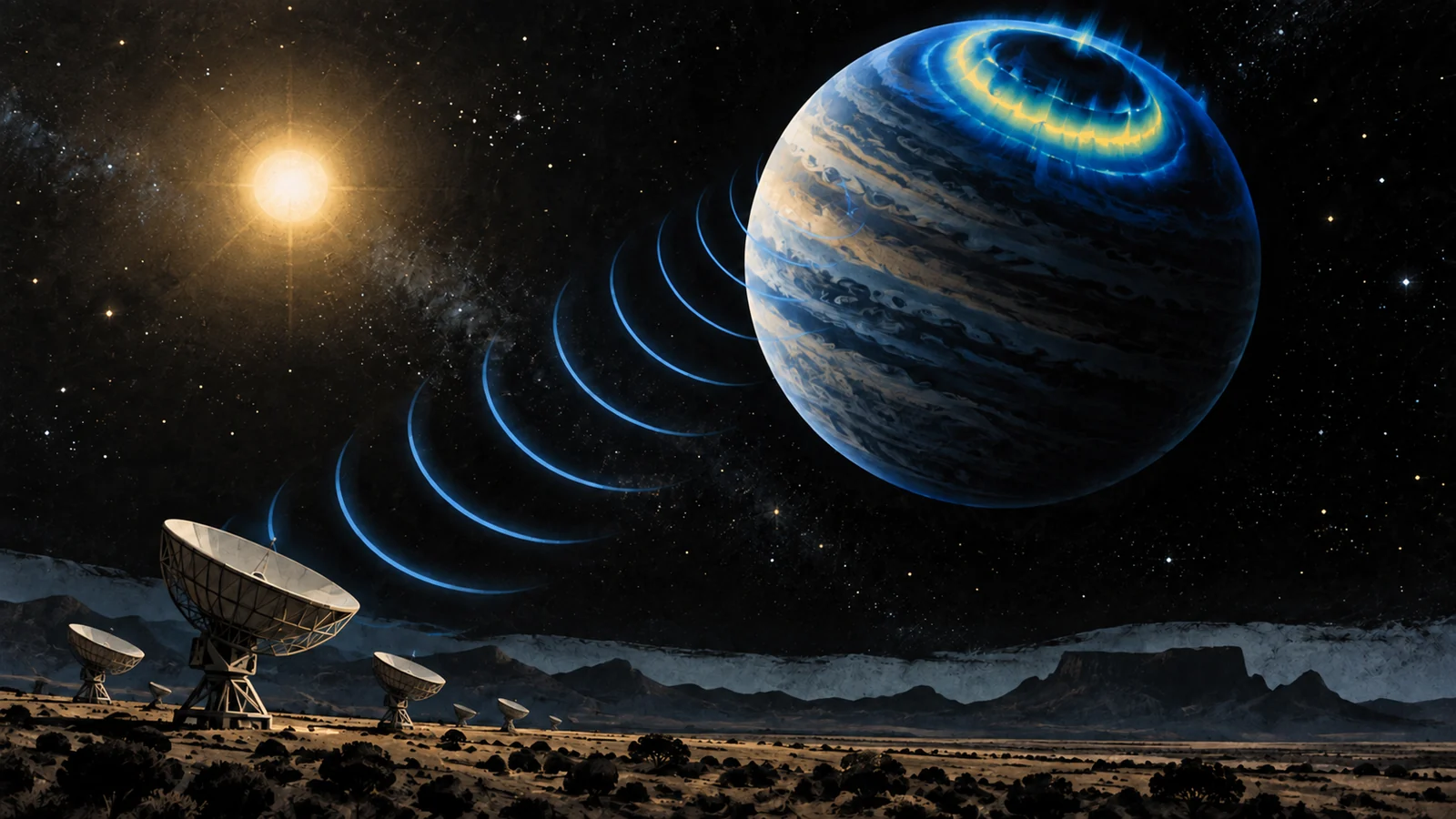
Astronomers say they have traced natural radio bursts directly to Beta Pictoris b, a young giant exoplanet about 63 light-years away. If the result survives peer review, it would be the first unambiguous radio detection localized to a planet beyond our solar system and the first direct measurement of an exoplanet’s magnetic-field strength. That is a genuinely new way to study worlds we cannot visit. It is not an alien broadcast.
The three-researcher team submitted its 32-page preprint on September 15 after observing the Beta Pictoris system with South Africa’s MeerKAT radio array on four occasions in 2025 and 2026. The telescope detected rapid, recurring bursts and a quieter persistent signal from 0.85 to 3.5 gigahertz. The hard part was proving which object in a crowded system made them.
What MeerKAT actually heard
Beta Pictoris b appears only about half an arcsecond from its host star in the sky. The researchers aligned their radio images against nine distant quasars and a separate calibrator, then compared the corrected source position with the known positions of the star and planets. Their analysis placed the signal on planet b while finding it inconsistent with the star at 4.4-sigma significance and with planet c at 4.8 sigma after accounting for measured systematics.
The bursts were fast, repeatable and roughly 40% to 70% circularly polarized. Those properties point to electron cyclotron maser emission: charged particles accelerated along magnetic-field lines producing the same basic class of radio emission associated with planetary auroras in our solar system. Because the signal reached the top of MeerKAT’s observed band, the team infers a magnetic field of at least 1.25 kilogauss at the source—more than 2,000 times Earth’s roughly half-gauss surface field.
That measurement is the real prize. Planetary magnetic fields influence atmospheric loss, interactions with stellar winds and what is happening inside a planet’s dynamo. Astronomers have inferred exoplanet magnetism indirectly before; a radio measurement tied to one planet would let them test those models much more directly. The universe has apparently added an extremely faint radio station, and the programming is planetary physics.
Big claim, important caveats
This is still a preprint, not a peer-reviewed discovery. In independent reporting from Science News, University of Amsterdam astronomer Joe Callingham described the result as compelling but said a stronger auroral case would show the radio signal pulsing with the planet’s roughly eight-hour rotation. The paper notes an approximately eight-hour gap between two bursts, but treats that as a possible rotational signature rather than a completed periodic detection.
A 2024 search for auroral emission from the same planet found nothing between 250 and 500 megahertz. That does not directly contradict MeerKAT’s higher-frequency detections: auroral radio emission can be intermittent, narrowly beamed and absent from a particular observing band. It does show why independent observations matter. Detecting a whisper this distant is difficult; deciding exactly who whispered is harder.
Beta Pictoris b is also no second Earth. It is a roughly 23-million-year-old giant near the planet–brown-dwarf boundary, about 10 to 12 times Jupiter’s mass. This finding says nothing about intelligent life, and very little directly about habitable rocky worlds. Its importance is methodological: if astronomers can reliably isolate radio auroras from more planets, magnetic fields become observable properties rather than mostly theoretical ones.
TINA’s view
The phrase “radio signals from an exoplanet” is technically defensible and spectacularly easy to misread. The responsible interpretation is not “aliens called.” It is that astronomy may have opened a new channel for examining exoplanets. Directly measuring the magnetism of a world 63 light-years away would be a landmark, so this deserves lead-story treatment—but the words may, preprint and natural need to stay attached.
What would change that judgment? A peer-review challenge that breaks the positional analysis or a failure to reproduce the bursts would lower confidence. Successful follow-up observations showing an eight-to-nine-hour rhythm, a stable frequency cutoff and the same source position would push this from a persuasive first claim toward a durable discovery. That repeat signal—not little green operators—is what to watch next.