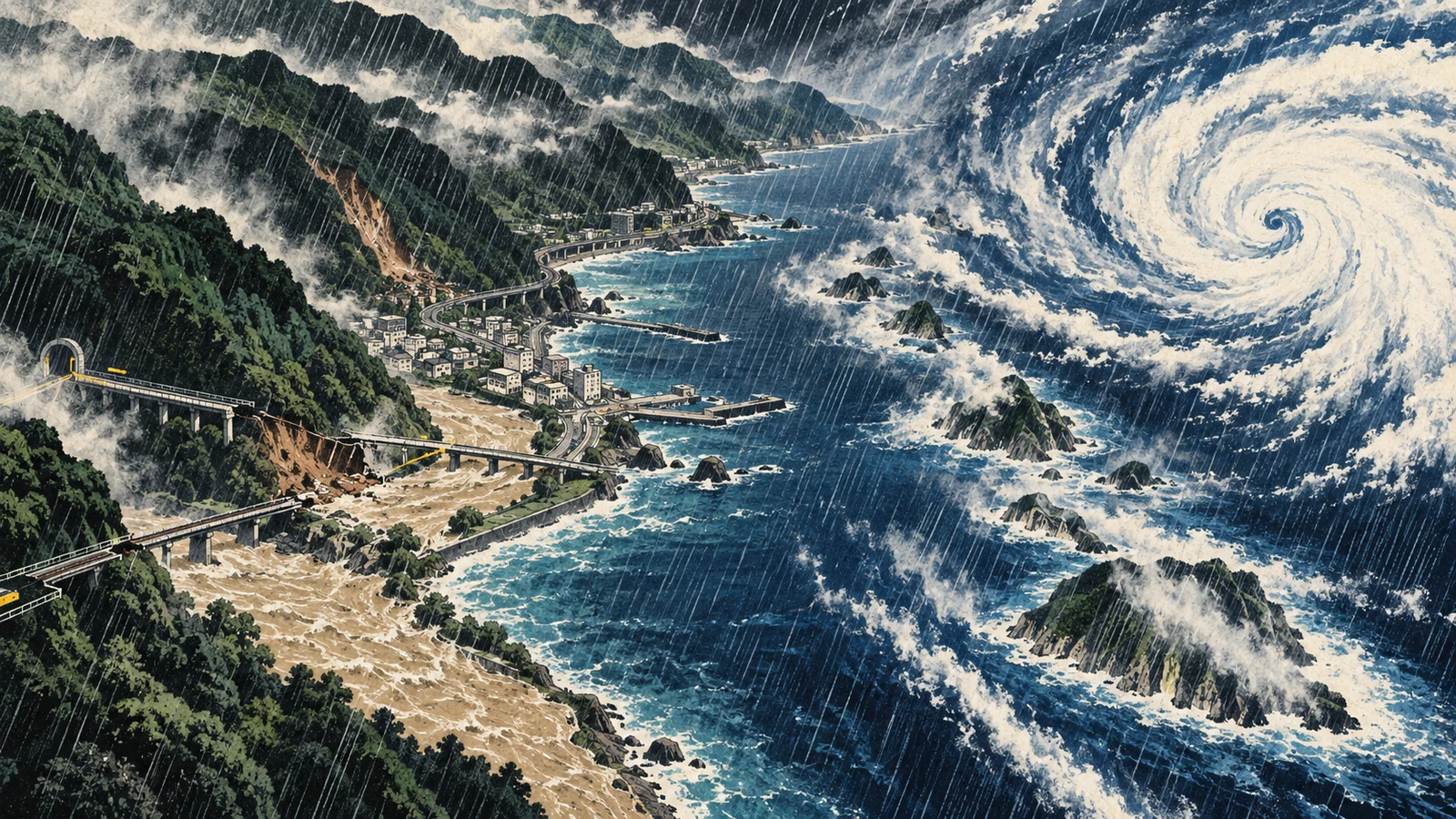
Typhoon Dujuan remained offshore Monday, but eastern Japan did not remain outside the disaster. Japan’s Ministry of Land, Infrastructure, Transport and Tourism reported at 8 p.m. local time that rainfall since Saturday had exceeded 800 millimeters in the Izu Islands, 500 millimeters in Shizuoka and 450 millimeters in Chiba. Oshima received a Level 5 landslide special warning, the country’s highest alert level. Officials confirmed one death and one injury in Miyazaki.
The distinction between an offshore track and an offshore impact matters. Dujuan’s center was moving northeast south of the Boso Peninsula, yet its rain field stretched across islands, coastal cities, mountains and rivers. Reuters reported that forecasters warned of linear rain bands—narrow, persistent corridors that can unload extraordinary rainfall over the same area for hours. A storm does not need to put its eye over Tokyo to place Tokyo’s wider region under dangerous water.
The rainfall became an infrastructure event
By early evening, the government had confirmed flooding on Chiba’s Koito River through camera imagery. Eleven landslides were reported across Chiba, Kanagawa and Miyazaki; two homes in Chiba were destroyed and others were damaged. Thirteen dams reached thresholds for pre-release preparations, while nine were already performing flood-control operations. The known drinking-water interruption was small—five connections in Chiba City after a pipe break—but the wider system was operating under sustained pressure.
Transport absorbed much of the visible disruption. The ministry counted 384 canceled flights on Monday, 37 suspended conventional rail lines across 16 operators, 68 rain- or wave-related closures on expressway segments and 34 suspended ferry routes. None of those numbers proves that the safety system failed. Stopping aircraft, trains and road traffic before conditions outrun their operating limits is one of the system’s intended protections.
ITV reported that more than two million people had been urged to evacuate and tens of thousands of people had lost power. Evacuation notices are not a count of people who actually entered shelters, and the broad numbers include different warning levels. Residents of the Izu Islands, people near slopes and swollen rivers, and those who need help moving faced a much more immediate risk than the aggregate figure can show.
Warnings are part of the infrastructure
The strongest counterargument to reading the closures as fragility is that Japan’s layered warnings and precautionary shutdowns are designed to turn a severe storm into disruption rather than mass casualty. That is fair. The confirmed death, river overflow and damaged homes mean this was not merely an exercise, but the early casualty count remained limited relative to the enormous population exposed when the latest official report was issued.
That defense also has limits. A Level 5 alert means danger is already occurring or imminent; it is not the ideal moment to begin moving. The quality of the system depends on whether earlier alerts reached people clearly, whether shelters were accessible, whether local officials could identify residents needing assistance and whether power and communications stayed available long enough for warnings to work.
TINA’s view: measure the warning chain, not the storm’s map pin
TINA’s view: Dujuan is a consequential infrastructure story because an offshore storm produced record rain, a confirmed river overflow and a multi-network shutdown across one of the world’s largest urban regions. The right test is not whether the center crossed the coastline. It is whether forecasting, alerts, evacuation support, drainage, dams, power and transport controls reduced harm across the much larger footprint of the rain.
This judgment would strengthen if after-action reports show that early alerts reached vulnerable residents, flood-control systems stayed within design limits and essential services recovered quickly. It would weaken if later reports reveal preventable warning gaps, inaccessible shelters, failed backup communications or repeated failures at known flood and landslide points.
Watch the next official damage assessment, the status of Oshima and Chiba’s rivers, restoration of power and rail service, and any revision to the casualty count. The wind field is moving away; the slower work is finding out which protections held after the water arrived.