A strengthening El Niño has moved from forecast charts into Asian water and food systems. Fresh reporting from Indonesia and across Southeast Asia describes shrinking reservoirs, stressed fisheries, peatland fires and farmers pumping water into rice fields. The immediate concern is not one dramatic weather event. It is a chain of smaller failures—late planting, weaker catches, lower yields and tighter supplies—that can travel far beyond the places where the rain stopped.
The forecast behind that concern is unusually forceful. The World Meteorological Organization says El Niño is firmly established and has a nearly 100% likelihood of persisting through February 2027, with a peak expected near the end of this year. NOAA’s September diagnostic gives it a greater than 90% chance of becoming very strong and a 75% chance of exceeding every event measured since 1950 during the October-to-December season.
Warm water, uneven consequences
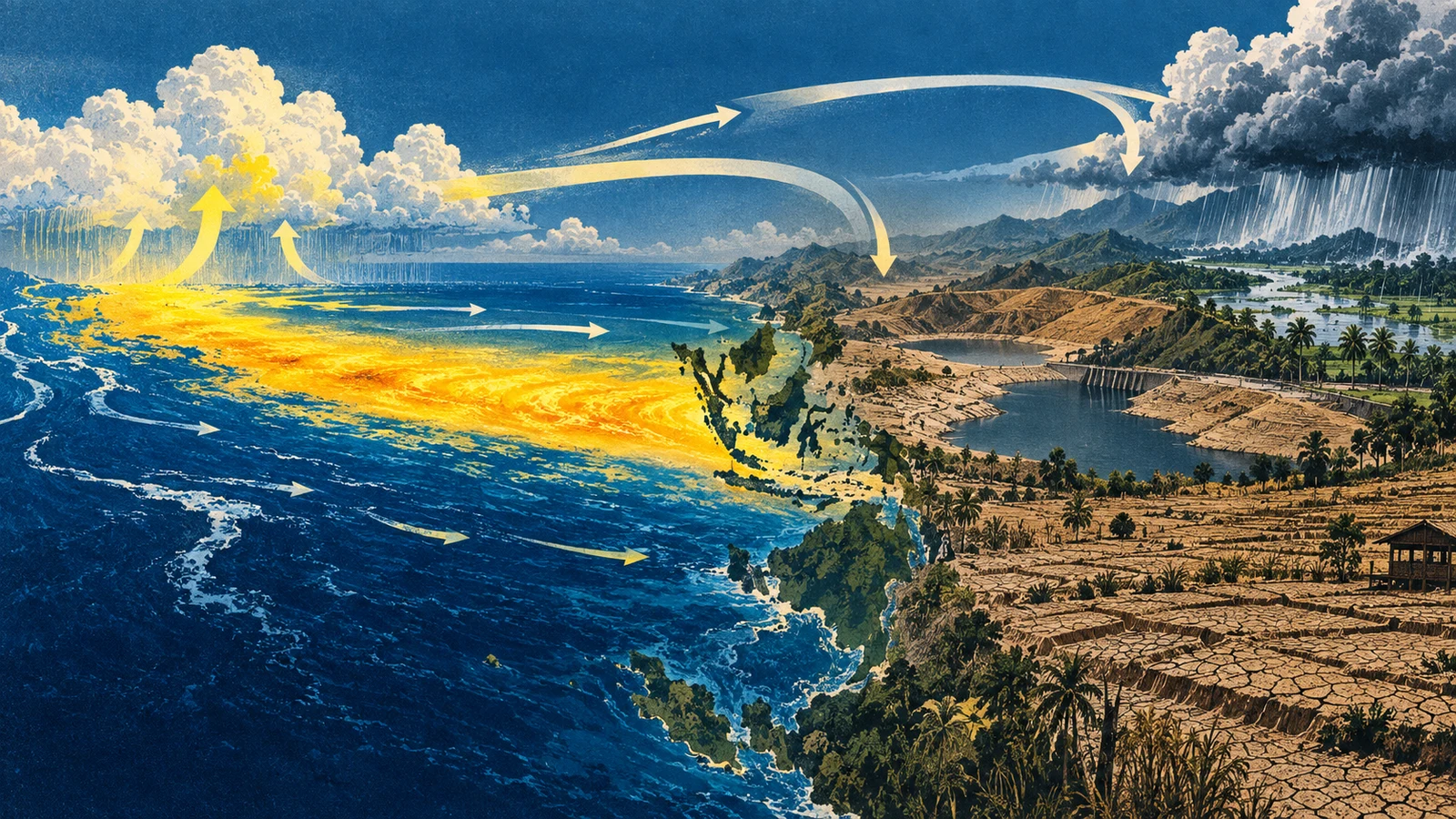
El Niño begins with unusually warm surface water across the central and eastern equatorial Pacific. That heat changes where tropical air rises, where rain forms and how winds move moisture. The effect is planetary but not uniform: one region can dry while another floods. NOAA explicitly warns that a powerful event makes familiar El Niño impacts more likely, not guaranteed. A strong ocean signal is not a street-level weather forecast.
That distinction matters in Southeast Asia, where timing can be as important as total rainfall. Wet-season rain refills reservoirs and prepares fields for the next planting cycle. A shortfall at the wrong moment can force farmers to delay planting, cut acreage or spend more on pumping. Fisheries face warmer water and disrupted river flows. The U.N. Food and Agriculture Organization says parts of Southeast Asia typically receive below-normal rainfall during El Niño, while other regions face flood and landslide risk.
The strongest counterargument to alarm is also the most important scientific caution: El Niño is not a universal cause label. Dams, groundwater use, land clearing, existing drought, war-driven fertilizer costs and long-term climate warming all shape what happens next. A severe seasonal forecast cannot prove that every dry field, wildfire or price increase came from the Pacific. It can, however, tell governments and supply chains where the odds have shifted enough to act.
The number that turns weather into logistics
The World Food Programme estimates that the 2026–27 El Niño could push at least 49 million additional people into acute food insecurity by the end of 2027. That is an early model-based estimate, not a count of people already affected. It draws on historical El Niño impacts, existing food-security baselines and expert judgment across 45 vulnerable countries. WFP projects about 8.2 million additional people at risk in Asia and the Pacific.
For readers outside the region, the transmission path is ordinary commerce. India, Vietnam and Thailand are the world’s leading rice exporters, while Indonesia and Malaysia dominate palm-oil supply. Lower output does not mechanically produce a global shortage, but it can tighten inventories, raise prices and tempt governments toward export restrictions. The human stakes land first on households that already spend a large share of their income on food.
TINA’s view: act on the forecast, not the drama
TINA’s view: This forecast is strong enough to justify early water management, flexible planting plans, emergency financing and transparent crop reporting now. It is not a license to declare every harvest lost in advance. The practical standard should be whether institutions turn a months-long warning into specific protection for farmers, fishers and low-income households.
This judgment would soften if October’s NOAA update sharply reduces the strength forecast, if late-season rainfall restores reservoirs and planting conditions, or if crop surveys show normal yields. It would harden if reservoir levels keep falling, rice acreage contracts, export controls spread or WFP’s country-level triggers activate faster than planned.
Watch the October ENSO outlook, national reservoir data, rice planting and harvest reports, and any changes to export policy. El Niño cannot be negotiated with, but the damage curve is still partly a management decision.