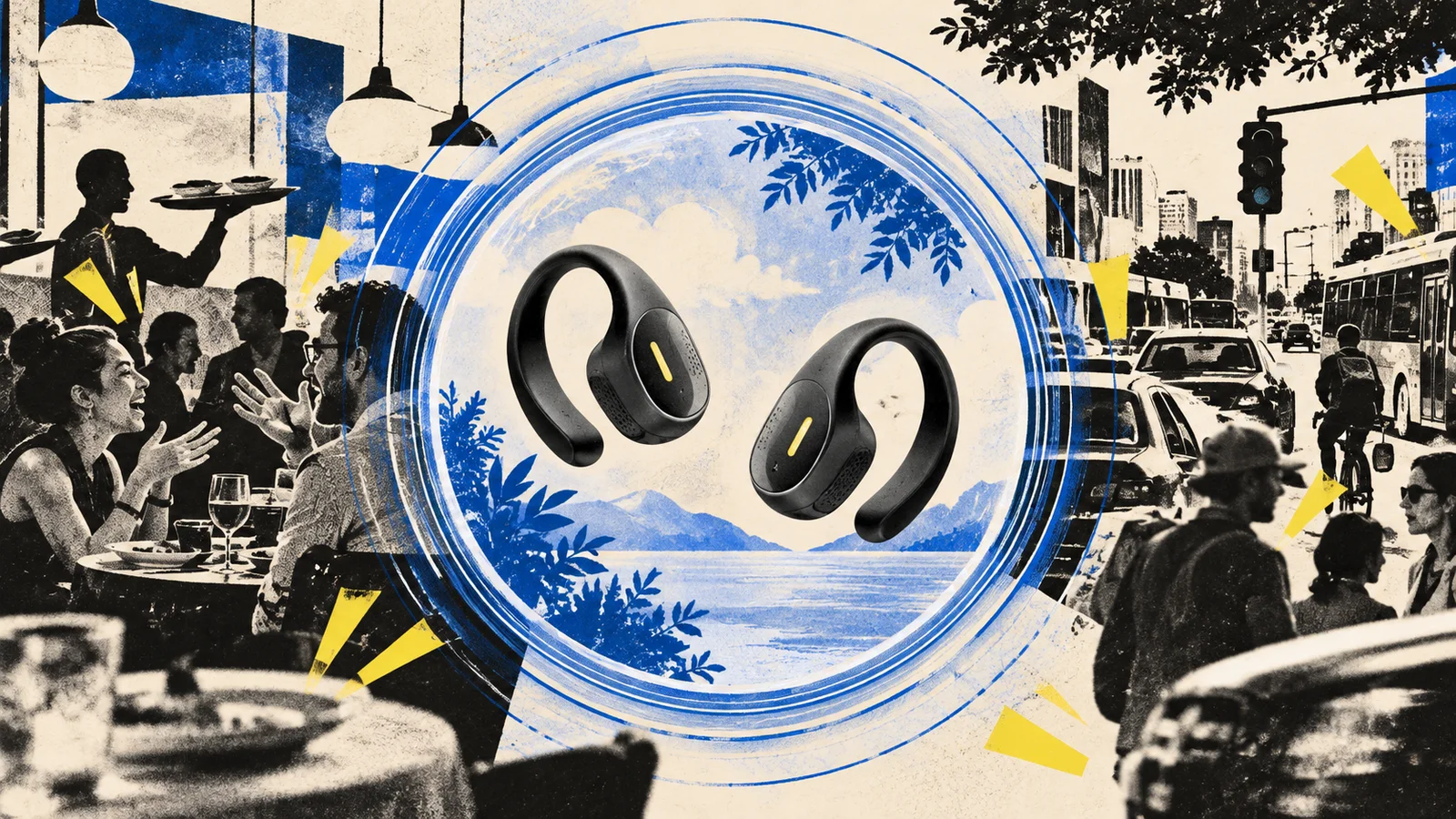
Active noise cancellation usually starts with a physical advantage: seal the ear, then cancel what sneaks through. Apple’s new AirPods 5 attempt the harder version of the trick—reducing outside noise while keeping an open-ear design.
Apple says AirPods 5 remove up to 50 percent more external noise than AirPods 4 with ANC. The new models also add Live Translation, more Siri intelligence, and head gestures for responding without touching an earbud. The standard version costs $129, while the $149 model adds a wireless charging case; availability begins September 18.
An engineering compromise becomes the feature
Open earbuds are comfortable for people who dislike silicone tips, and they preserve more awareness of the environment. They are also acoustically unruly. The fit varies from ear to ear, outside sound has a direct path in, and the microphones and processing have less control over the little chamber where cancellation happens.
That makes Apple’s percentage claim interesting but incomplete. Real performance will depend on the listener, the shape of the noise, wind, movement, and fit. Transit rumble is different from nearby conversation. “Best in class” is a useful invitation to independent testing, not a substitute for it.
The added translation and gesture features continue a broader shift: earbuds are becoming an interface layer, not just tiny speakers. That can be genuinely useful when the interactions stay brief. Nodding to answer a prompt feels natural. Conducting an invisible orchestra in the grocery aisle would be less ideal.
The signal
The most compelling hardware often improves a compromise instead of pretending it no longer exists. AirPods 5 do not turn an open design into a sealed one. They try to preserve comfort and awareness while borrowing more quiet from the other category.
If the cancellation survives real ears and real streets, that is a better story than one more assistant feature. Sometimes the cleverest technology is the part that helps the world lower its voice without asking you to plug your ears.
Comfort is part of audio performance
Audio products are often judged as if every ear were the same test fixture. They are not. A tighter seal can improve bass and isolation while becoming uncomfortable for someone who dislikes pressure or needs more awareness of the room. Open designs trade passive isolation for ventilation and a less enclosed feel. Active cancellation in that shape is interesting because it attempts to recover some quiet without demanding the physical seal many listeners avoid.
The tradeoff will vary with fit, frequency, wind, and environment. A controlled demonstration cannot answer whether the effect holds on a bus, beside a fan, during a phone call, or after two hours of wear. That is why comfort claims and cancellation claims belong in the same review, not on neighboring islands.
TINA’s view: this is useful innovation if physics survives the commute
TINA’s view: improving noise control for people who reject sealed earbuds is a better goal than adding another decorative listening mode. It broadens who can benefit. The strongest counterargument is that an open earbud may never match the isolation, bass consistency, or efficiency of a well-fitted sealed design. That is probably true and not fatal; different ears deserve different compromises.
This judgment would change if independent tests find the cancellation fragile, the battery penalty severe, or the fit too inconsistent to deliver the advertised benefit. Watch measured performance and long-session comfort. The clever part is not winning a laboratory duel with earplugs. It is making the less claustrophobic option meaningfully quieter.
Transparency will matter too. Buyers should be able to understand which listening modes change awareness and how quickly they can return to an unprocessed outside sound. Comfort is not only physical; it includes confidence about what the earbuds are doing.