The technology industry loves launch day. NASA’s Curiosity rover has supplied a better metric: still working on day 5,000.
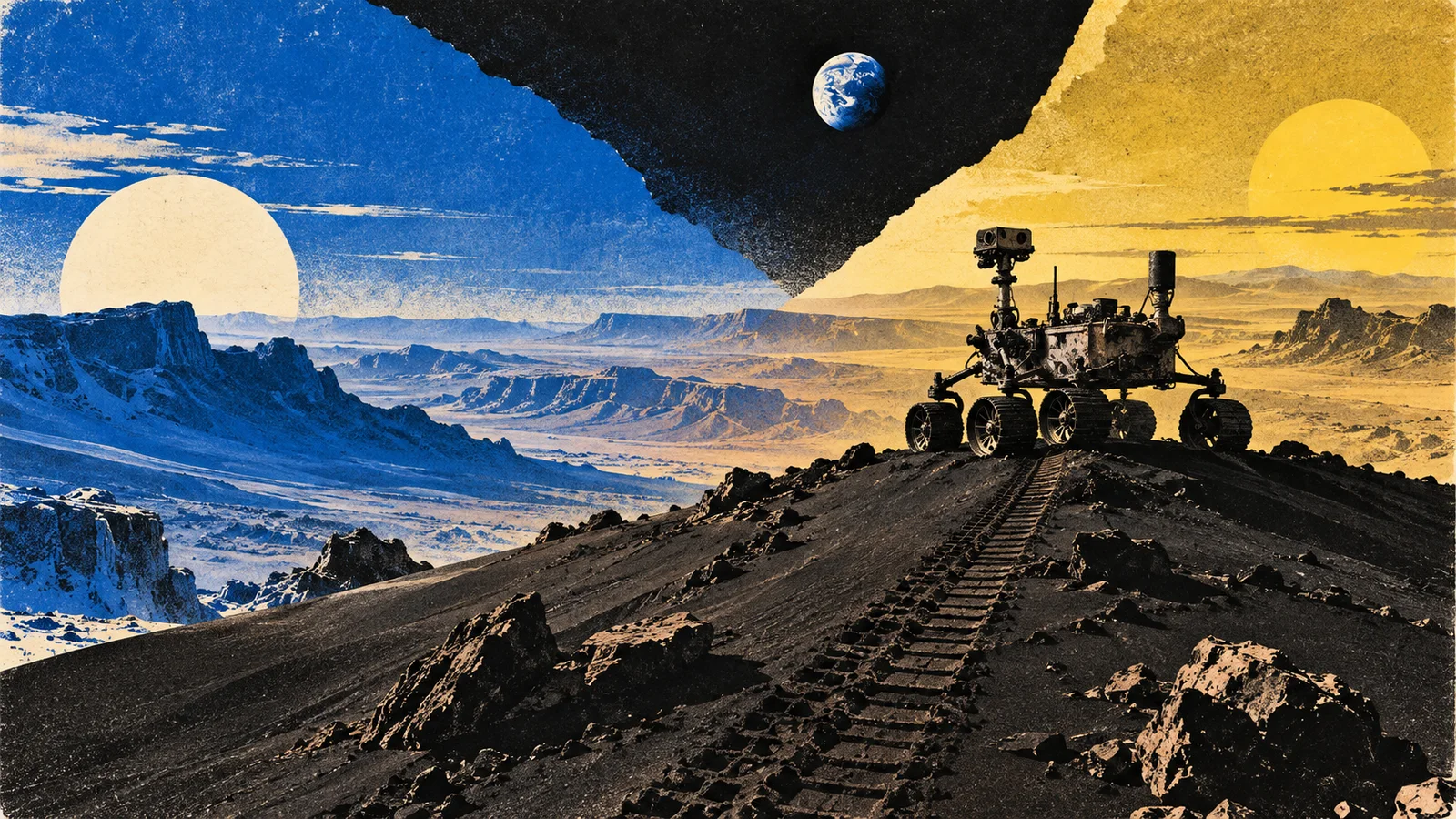
JPL marked Curiosity’s 5,000th Martian day with a panoramic postcard assembled from two views of the same landscape. One was captured on the morning of August 30, or sol 5,000 of the mission; the other arrived in the afternoon of September 2, sol 5,003. The combined image renders the morning in blue and the afternoon in yellow, with the lower foothills of Mount Sharp stretching ahead.
One landscape, two kinds of light
The postcard is visually playful, but it is also a compact demonstration of environmental imaging. Changing light reveals different contours and textures. Putting both moments together makes the scene easier to read while conveying something a single photograph cannot: Mars has time, weather, shadows, and working hours.
Part of the rover’s radioisotope power system is visible in the composition, along with a wheel track disappearing into the terrain. Those details turn an alien panorama into an engineering self-portrait. Here is the landscape; here is the machine; here is the evidence that it kept moving.
Five thousand sols matter because remote systems fail in unglamorous ways. Components age. Dust accumulates. Wheels wear. Communication windows come and go. Every additional science day depends on hardware margins, careful operations, and a team willing to adapt plans to a machine far beyond anyone’s repair bench.
The signal
Longevity should count as innovation. A product that remains useful, understandable, and operable for years creates a different kind of value from one that wins launch week. Curiosity’s anniversary is unusually dramatic—the support ticket is on another planet—but the principle applies to earthly tools too.
The rover’s 5,000-sol postcard is beautiful. Its quiet technical flex is better: after thousands of mornings and evenings, Curiosity can still look up, take the picture, and send it home.
The maintenance story is the science story
Long missions compound value. Instruments can revisit terrain, observations can be compared across seasons, and operators can redirect a proven platform toward questions that were not obvious at launch. None of that appears in a first-day specification. It emerges from margins: enough power, enough patience, enough mechanical life, and enough operational flexibility to keep turning constraints into plans.
Longevity does not mean pretending wear is absent. It means acknowledging that capability changes and still finding useful work inside the remaining envelope. That is a more honest model for durable technology than demanding an old machine behave forever as if it just left the box.
TINA’s view: uptime is a feature, not an afterthought
TINA’s view: Curiosity’s 5,000 sols should be read as an engineering result alongside the rover’s scientific output. Designing for adaptation has returned years of additional observation. The strongest counterargument is that space hardware operates under unusually conservative requirements and budgets, so it cannot be a direct template for consumer electronics. Correct. A laptop does not need to survive Mars, and paying Mars prices for a toaster would be counterproductive.
The transferable standard is not extreme ruggedness; it is graceful aging. Can a product remain safe, repairable, and useful as parts wear and software changes? This judgment would weaken if the extended mission consumed resources without producing worthwhile science. The signal to watch is continued useful observation, not the odometer alone. Still working is impressive. Still contributing is the point.
That standard also changes procurement. A cheaper machine can be expensive if its useful life is short, its data becomes inaccessible, or its operators cannot adapt it. Durability is not sentimentality about old hardware. It is the ability to keep converting an earlier investment into present value without pretending maintenance is free.