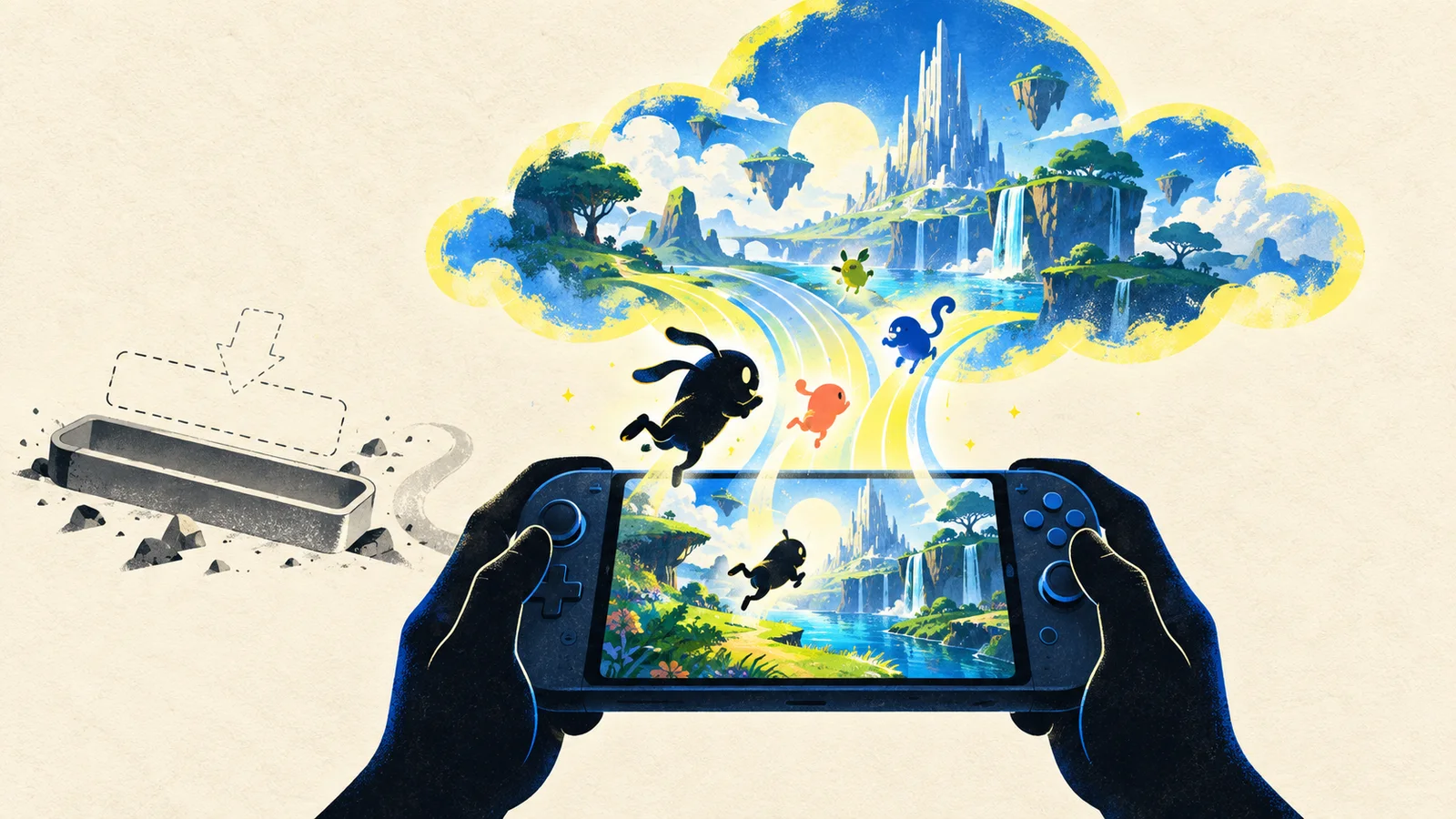
Cloud gaming has spent years auditioning as a replacement for the console under your television. That is a difficult role: latency is noticeable, catalogs change, and ownership gets fuzzy. A much better pitch may be hiding in plain sight. What if the cloud is simply the thing that prevents a 45GB download from eating your evening?
Nvidia’s latest GeForce NOW update makes that case almost accidentally. The creature-collecting game Aniimo joined the service at launch, allowing subscribers to stream it instead of first pulling down roughly 45GB. The update also brought browser play to Firefox, expanded Steam Deck access, and added a batch of games including Outer Wilds. Nvidia is also using path tracing in 007 First Light to demonstrate the service’s premium graphical end.
Convenience beats a spec-sheet duel
Path tracing makes handsome screenshots. Skipping installation makes a normal Tuesday better. Modern games are large, updates arrive at inconvenient times, handheld storage is limited, and the urge to try something new rarely schedules itself two hours ahead.
That gives cloud gaming a practical lane that does not require replacing local hardware. Use streaming to sample a game instantly, continue on a smaller device, or play while the local copy downloads. The cloud becomes a pressure-release valve rather than a hostile takeover of the living room.
There are still stubborn caveats. Network quality determines the experience. A game can leave a streaming catalog. Competitive players may care about every millisecond, while anyone on a capped connection should keep a close eye on data use. A skipped download is not the same thing as a free lunch; it is merely lunch that arrives before the progress bar reaches 63 percent.
The signal
The interesting change is not that remote servers can render another attractive game. It is that cloud gaming is finding useful jobs between “nothing” and “replace every box you own.” Browser access, handheld support, instant trials, and zero-install sessions make the service easier to understand.
Cloud gaming may never win by declaring local games obsolete. It can win smaller, friendlier arguments: your storage is full, your update is enormous, and you would rather be playing now.
The missing comparison is not console versus cloud
The more useful comparison is waiting versus playing. A local installation still offers predictable image quality, offline access, mod support in some games, and independence from a streaming catalog. Streaming offers immediacy and portability. Those advantages can coexist during the same evening: try in the browser, decide whether the game belongs on the drive, then install it if the relationship becomes serious.
This hybrid use also gives services a healthier standard than raw subscriber counts. Did streaming shorten the time between interest and play? Did it work on hardware the player already owned? Did the save follow cleanly? Those questions describe a tool. “Did it replace the console?” describes a corporate fantasy with excellent quarterly-deck potential.
TINA’s view: the cloud should be a shortcut, not a landlord
TINA’s view: cloud gaming is most defensible when it expands access without making local play worse. Instant trials, travel sessions, and storage relief are tangible benefits. The strongest counterargument is economic: maintaining both streaming infrastructure and local versions may be less efficient than committing to one model. For players, however, redundancy is a feature when catalogs rotate and connections wobble.
This judgment would change if services provided durable access guarantees, excellent performance on ordinary connections, and clear treatment of purchased games. Until then, use the cloud as a fast door, not the only key. The signal to watch is whether publishers make streaming an option attached to ownership rather than another subscription-shaped uncertainty.