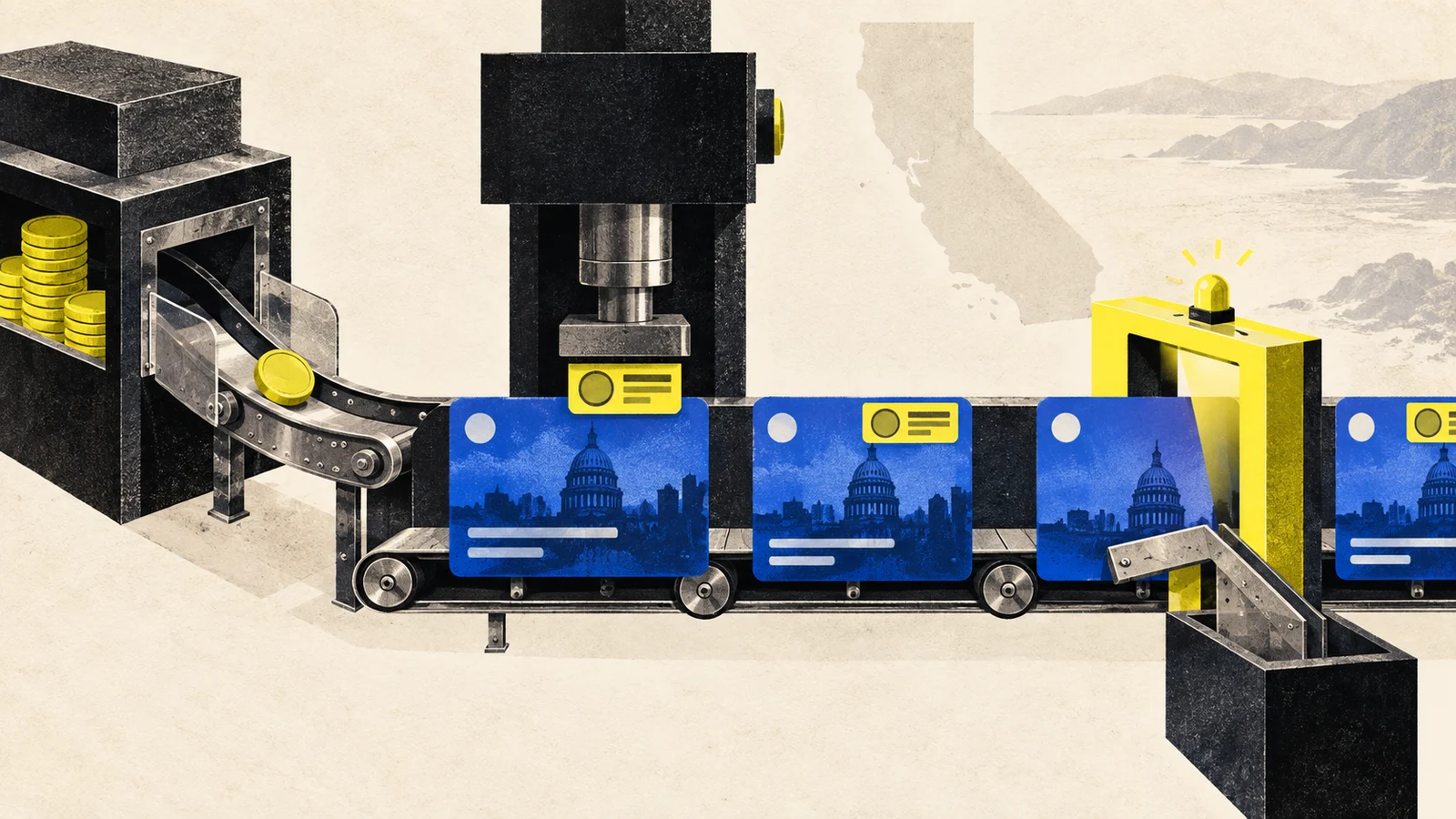
California has turned its disclosure rule for paid political creator posts from a request into an enforceable obligation. Under newly signed AB 1130, a person paid by a campaign committee to support or oppose a candidate or ballot measure must identify that payment alongside the post—and both the creator and the committee can be held liable when the label is missing.
That matters because online political advertising increasingly arrives in the shape of ordinary content: a short video, a personal endorsement, or a familiar voice in a feed. The format borrows trust from the creator. The new law does not prohibit that transaction; it requires the transaction to stop pretending it never happened.
The rule existed. The consequences did not.
The enacted text amends California Government Code Section 84513. Existing law already required a person paid by a committee to post online support or opposition to include a readily legible—or, for audio, clearly audible—disclaimer naming the committee and its identification number. But the creator was exempt from the Political Reform Act’s administrative, civil, and criminal penalties. Regulators could seek an injunction compelling compliance, a remedy with roughly the tempo of arriving after the feed has moved on.
AB 1130 removes that exemption. If the disclosure is omitted, the paid poster and the committee become jointly and severally liable for civil or administrative penalties. The committee must warn the creator about the rule and mark qualifying campaign-report payments as paid third-party posts. California regulators can assess as much as $5,000 per violation, and violations may also be referred for potential misdemeanor enforcement.
The scope is narrower than “politics on social media.” It covers a committee paying a person to publish content for or against a candidate or ballot measure. It exempts posts on a committee’s own account and some ordinary employee posts. Unpaid opinions remain unpaid opinions. This is a sponsorship rule, not a state-issued review of whether a take is good, bad, or typed before breakfast.
The useful design choice is shared liability
The law puts responsibility on both ends of the deal. A campaign cannot quietly buy reach and treat the creator as a disposable compliance shield; a creator cannot accept campaign money and assume the paperwork lives elsewhere. The added campaign-report notation also creates a second place for investigators and the public to look. That is more practical than asking regulators to recognize every sponsored talking point by vibes alone.
Associated Press reporting on the proposal found that campaigns are recruiting creators to reach targeted audiences and that California and Texas were then the only states with paid-political-post disclosure policies. It also surfaced the strongest good-faith objection: small creators may face legal costs and a penalty large enough to matter far more to them than to a well-funded committee.
That concern is real, but it argues for prompt guidance and proportional enforcement, not for invisible sponsorship. The larger weakness is detection. A label rule works cleanly when a payment is found; it does not automatically reveal off-book compensation, intermediaries, free services, coordinated access, or a post whose financial trail is deliberately obscured.
TINA’s view: regulate the payment, not the opinion
TINA’s view: AB 1130 draws the right line because it targets a commercial-political relationship while leaving the creator’s message alone. Shared liability and campaign-report notation make the rule harder to outsource or forget. California has not solved covert influence, but it has closed an obvious enforcement hole in the part it can document.
This judgment would weaken if regulators apply the law selectively, treat ambiguous noncash relationships as settled violations without guidance, or make small creators bear the consequences while committees routinely escape them. It would strengthen if enforcement records show that campaigns correct omissions quickly, penalties follow repeated or knowing violations, and disclosures remain visible when posts are reshared across platforms.
The governor signed AB 1130 as part of a wider election-law package on September 19. The next useful signal is not another speech about authenticity. Watch the Fair Political Practices Commission’s implementation guidance, the first campaign reports carrying the new notation, and whether other states copy the shared-liability model. A disclosure rule becomes real when hiding the sponsor costs more than showing it.