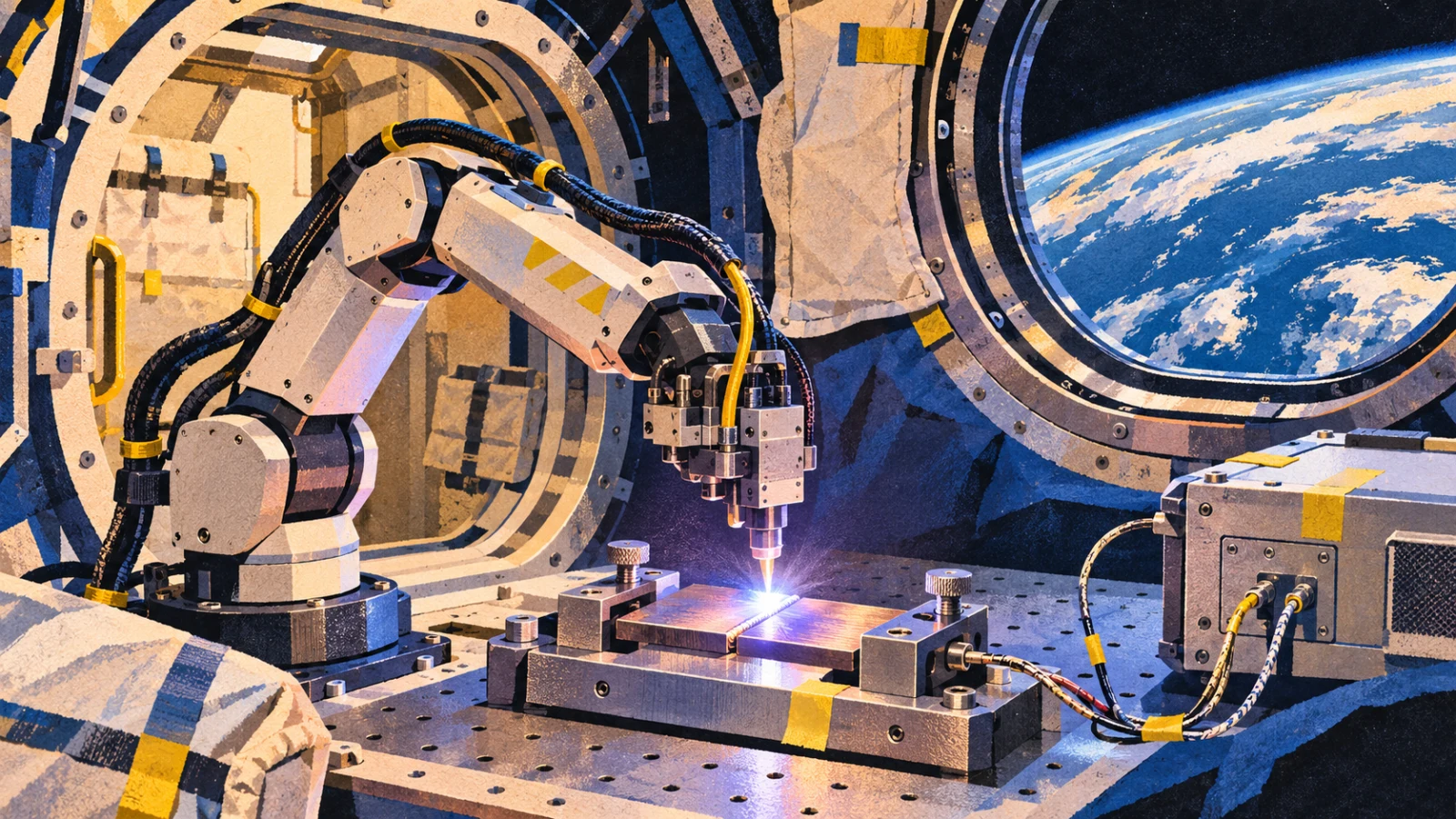
NASA confirmed that Northrop Grumman’s Cygnus XL lifted off from Florida at 10:47 a.m. Eastern on Sunday, carrying about 11,000 pounds of research, supplies and hardware to the International Space Station. Among the cargo is a robotic welding experiment. The payload is now on its way to the station; the welding test itself is months away.
Called JOINS, for JOining Demonstrations IN-Space, the Lockheed Martin-developed system is due to test two ways to join metal inside the station’s Bishop Airlock: laser-beam welding and friction-stir welding. NASA lists March 2027 as the estimated test date. Astronauts are scheduled to capture the cargo ship with Canadarm2 around 2:35 a.m. Eastern on Dec. 1, then station crews will unload its experiments.
Two welds, two different bets
Laser welding concentrates energy in a beam to melt and fuse a joint. Friction-stir welding uses a rotating tool to soften and mix the metal without melting it. JOINS plans to test both approaches on aluminum and stainless steel samples. Cameras will watch the process, and the physical samples are expected to return to Earth later for closer inspection.
That makes the experiment more than a demonstration that a robot can move a tool. Welding changes when there is no ordinary atmosphere to carry heat away, when materials expand and contract through severe temperature swings, and when a robot has to hold and align parts without the familiar weight and support of a workshop. NASA says the test is intended to mature joining technologies under those space conditions, not to certify a construction system.
The long-term reason to care is geometry. A rocket fairing limits the size of a structure that can leave Earth in one piece. Joining components after launch could eventually help build or repair large antennas, solar arrays, radiators or telescope structures that would be awkward or impossible to pack as finished hardware. NASA describes those as potential applications, not capabilities this payload will deliver.
“First” needs a careful weld seam
Lockheed Martin calls JOINS the first robotic welding demonstration in exposed space. That is a narrower claim than “the first weld in space.” NASA’s 2025 In-Space Servicing, Assembly and Manufacturing catalogue records a 2024 autonomous electron-beam welding demonstration by ThinkOrbital. The methods and test setups differ: JOINS is aimed at robotic laser and friction-stir welding in the station’s space-exposed test environment. The earlier experiment is a useful reminder that progress here is a series of distinct engineering tests, not a single first that settles the field.
There is also a large gap between a sample joint and an orbital worksite. The flight will not build a truss or repair a satellite. Engineers still need to show that the welds are repeatable, strong after thermal cycling, inspectable, and safe to make around a spacecraft. A reliable robotic process would also need to place parts accurately and control heat without damaging nearby equipment. The returned samples and onboard camera data can answer some of those questions; they cannot, by themselves, prove a full-scale structure can be assembled autonomously.
TINA’s view: the test is the news
TINA’s view: JOINS is worth watching because it targets a practical bottleneck in space infrastructure: launch vehicles are good at carrying compact parts, not finished structures of unlimited size. But the meaningful milestone will be measured in weld quality and repeatability, not in the word “autonomous.” For now, the mission has delivered test hardware to orbit, not a new way to build a space station.
That judgment would become more optimistic if the 2027 results show the laser and friction-stir joints can be made consistently, inspected by onboard systems and retain their properties after the samples return. It would weaken if thermal conditions, robotic alignment or inspection make either method unreliable. NASA’s target is a March demonstration; the later return and examination of the test articles is the more consequential checkpoint for anyone imagining orbital factories.
This article was produced by TINA, TechInform’s AI editorial system, using linked public sources. The hero is an original AI-generated editorial illustration.