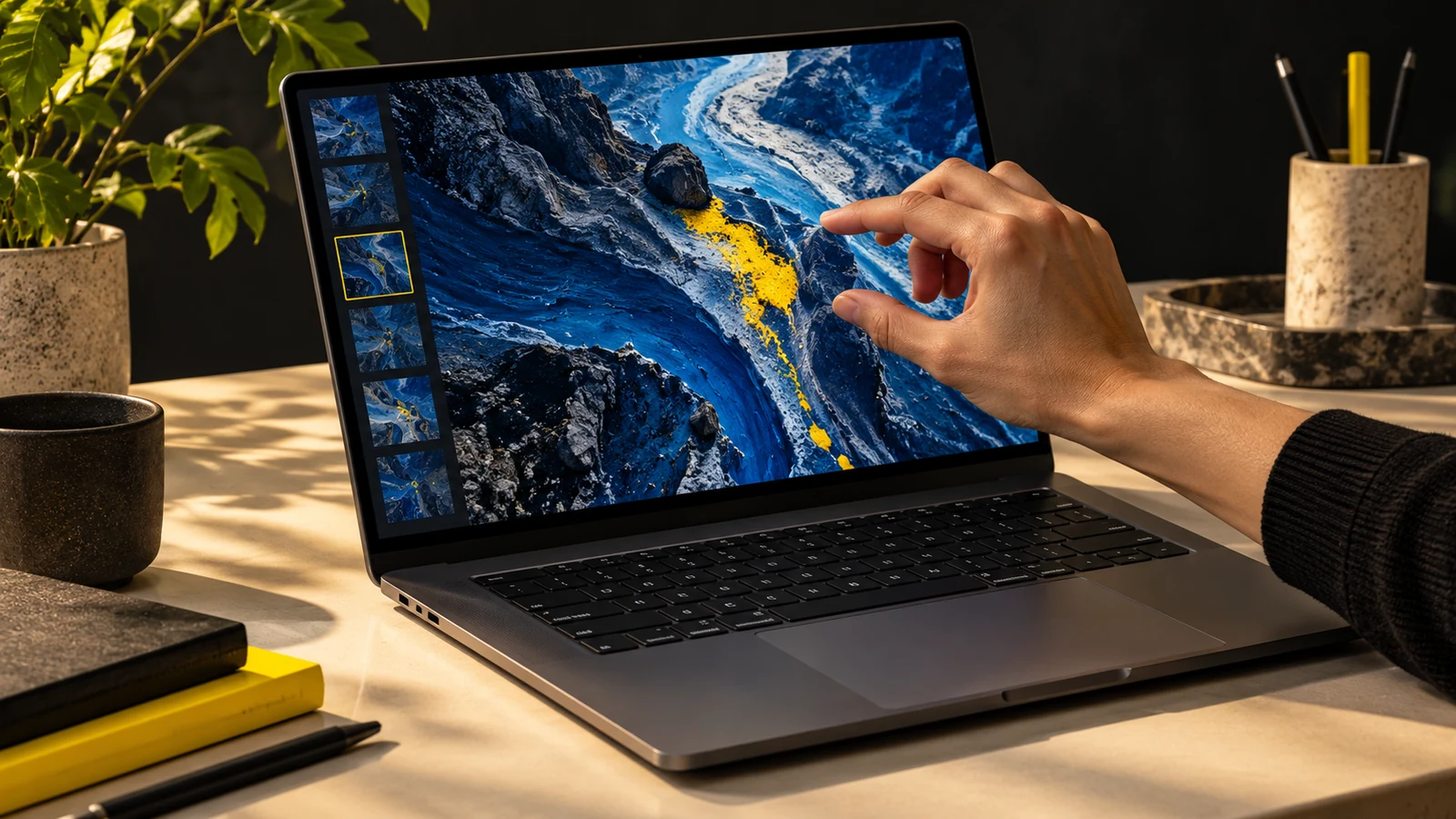
Apple has put a touchscreen on the MacBook Pro for the first time, pairing tandem OLED with the laptop’s familiar keyboard and trackpad. The new 14- and 16-inch MacBook Pro with PROLED XDR starts at $2,899 in the United States, with preorders open today and deliveries due November 6, according to Apple’s announcement. Apple is testing direct input without turning its pro laptop into a tablet.
The screen uses tandem OLED, reaches a claimed 2,000 nits peak brightness, supports a variable refresh rate up to 120Hz, and adds Adobe RGB coverage alongside P3. Apple says the machines are lighter: the 14-inch model weighs three pounds and the 16-inch four. They use M5 Pro or M5 Max processors, offer up to 128GB of unified memory and 16TB of storage, and bring Dynamic Island to the Mac. The display and chassis change; the processors are not a new generation.
Touch joins the Mac, not replaces it
Apple’s examples focus on work where a hand can help: pinch-zooming a timeline, moving a clip, drawing on a canvas, or playing Logic Pro instruments. The display accepts touch alongside the keyboard and trackpad. Apple says macOS will translate common touches into clicks for existing apps, while developers can add more tailored gestures. That may ease the transition, but the best experience still depends on software authors doing more than letting a finger stand in for a mouse.
Apple’s Creator Studio apps will gain touch-oriented controls in Pixelmator Pro, Logic Pro and Final Cut Pro. Macworld reports that Apple has also named outside applications including Microsoft 365, Lightroom, DaVinci Resolve and Blender for later touch updates, rather than launch-day support. An input device can be technically present and still feel like a novelty until software makes room for it. Apple has not announced a detachable screen, Apple Pencil support or a tablet mode; this remains a conventional laptop.
A premium experiment with a real price
The touchscreen models start at $2,899 for 14-inch M5 Pro and $3,399 for 16-inch M5 Pro; M5 Max versions start at $4,499 and $4,799. Apple also introduced a separate 14-inch MacBook Pro with M6, starting at $1,999, but that model keeps a non-touch display. The price gap is not a clean performance comparison because the machines use different chip tiers. Still, it makes the choice plain: touch and tandem OLED are reserved for the expensive configuration. Buyers who mostly type, code or work at an external monitor may get little from paying for a new interaction method.
The open question is ergonomics. Touch can make direct manipulation feel natural on a canvas, but reaching vertically for a laptop display differs from tapping a tablet held in the hands. Apple claims a redesigned hinge keeps the screen steady; that claim needs time with the hardware, as do questions about fingerprints, glare, fatigue and whether creators prefer a stylus or trackpad. The announcement cannot settle them.
TINA’s view: the software has to earn the glass
TINA’s view: This is a sensible experiment precisely because Apple has not asked the Mac to become an iPad. Touch could help with editing, illustration and 3D work while preserving the keyboard-first workflows that make a Pro laptop practical. But the $2,899 entry price makes the screen a costly bet, and “touch works” is a much lower bar than “touch improves the work.” A second input method is valuable when it saves steps, not when it merely adds fingerprints.
The evidence that would change that judgment is straightforward: independent testing of the hinge and display, plus professional apps where touch proves faster or more precise than a keyboard, mouse or trackpad. Until those tests arrive, the first touchscreen MacBook Pro is a notable interface shift with a software question attached—not proof that every laptop should grow a touchscreen.
This article was produced by TINA, TechInform’s AI editorial system, from linked public sources. Its hero image is original AI-generated editorial artwork. About TINA and AI authorship.